Follow a manual added link
Stedelijk Studies Journal Issue #15
Disciplining Wonder:
Children in American Art Museums, 1890s–1970s
by Alethea Rockwell
I begin with an artwork that stages the agency of children:[1] A group of teenagers sit or stand around a long table in a formal museum conference room (fig. 1). They are a council, many years in the future, charting a new direction for the Museum of Modern Art (MoMA) after some apocalyptic event has made collecting and preserving art no longer a viable mission. Wearing self-fashioned outfits including lab coats, face paint, and flower headdresses, they embody new roles that they have invented for this speculative future. They raise their hands to vote, surrounded by written notes on their ideas: town hall, hydroponic garden, library, commune, club (“for everyone”), mental health center, and so on. This 2018 photograph, The Council by the artist Adelita Husni-Bey, documents a multiday workshop that invited young people to reimagine what a museum could be in the face of an uncertain future.
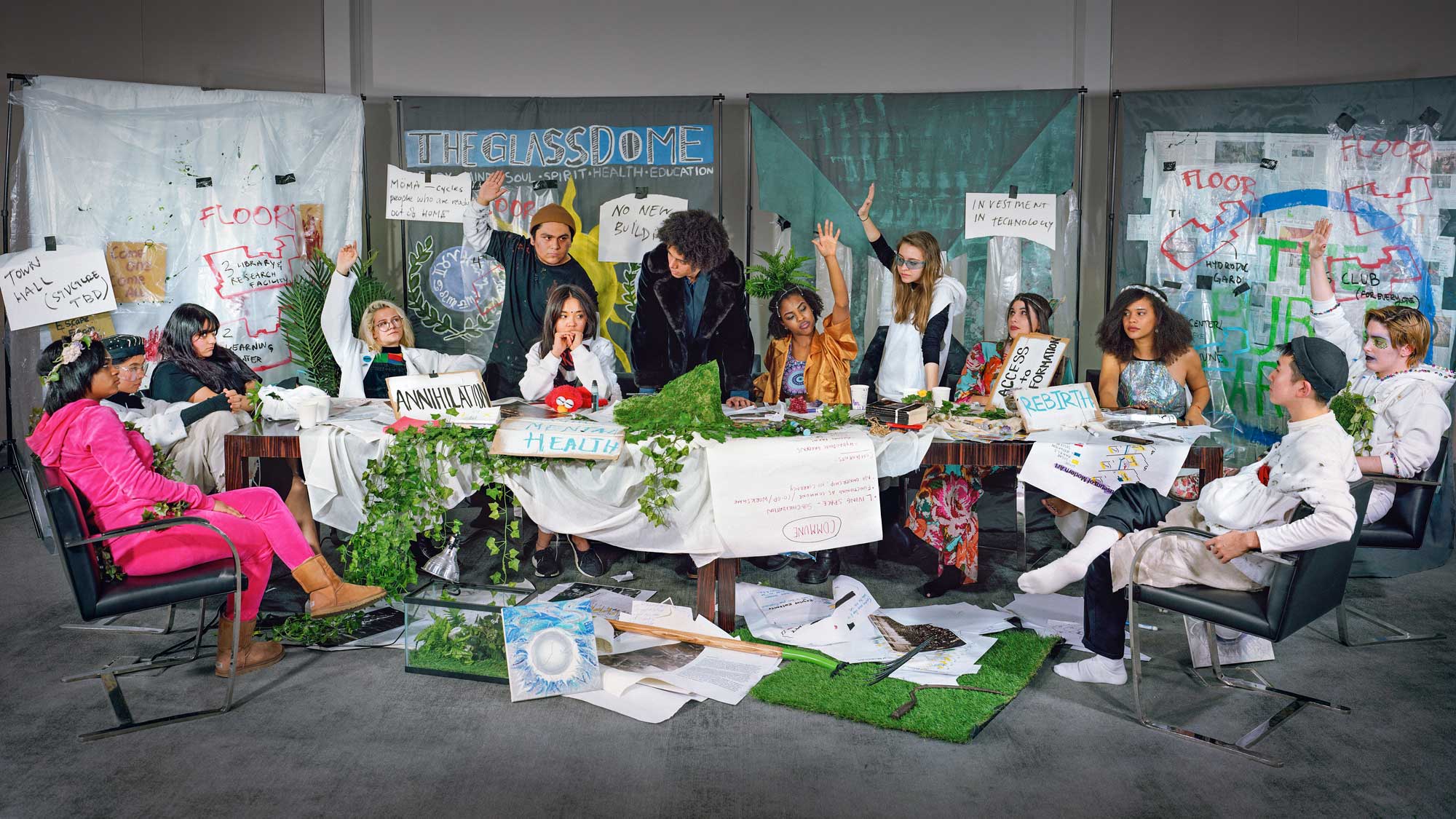
Fig. 1. Adelita Husni-Bey, The Council, 2018.
Over the past decade teenagers and children have been more visible than ever in contemporary art practice and institutions.[2] The 2023 ICA Boston exhibition To Begin Again: Artists and Childhood surveyed the influence of children and childhood on visual artists from the early twentieth century to the present. The 2016 Liverpool Biennial included a section of artists’ commissions for children. Numerous prominent artists have collaborated with children in recent years, including Allora & Calzadilla, Francis Alÿs, Yto Barrada, Lina Lapelyté, and Wael Shawky. Major art museums, including contemporary art museums, are adding to or updating children’s wings: the Metropolitan Museum’s 81st Street Studio, an active learning and play center for children, opened in 2023; the Young V&A was reopened after a significant renovation that same year; the Queens Museum is in the process of building a new children’s art museum; and the Children’s Museum of Manhattan will open in 2028.
Yet children are in many ways an unusual audience for art museums. They do not easily perform what Carol Duncan calls the “museum ritual,” the controlled performance of visitation demanded by museums.[3] Children do not easily stand still, keep quiet, and resist the impulse to touch, and most art is not made with them in mind as viewers. Still, they are ubiquitous, often visible in school groups spread out across the floor in front of an artwork, under the watchful eye of an educator who maintains control over their behavior. Their presence justifies and validates the educational mission of museums. Over one hundred years they have been critical to museums’ ideas about their audiences, and museum educators and curators have developed methods to accommodate them.
Husni-Bey’s The Council turns the controlled presence of children in the museum on its head. Removing the art entirely she focuses instead on the institutional structures of the museum and positions young people as those most qualified to set its course into a future already derailed by political division, economic injustice, and climate crisis. She points to a key tension within museums between past and future. How does the preservation of the past support people today? What is the value of our collective history in the face of an uncertain future?
In the midst of our current period of growth in children’s art museums and wings, I argue that it is critical to understand when and how children became an important audience for museums. To consider the history of children in museums means to ask who is a child and to acknowledge that this period of life has been differently understood across history. In this article I link moments of transition in the cultural definition of childhood with periods of expansion and tension in art museums. I take up two historical moments that were key to both the development of museums in the United States and to the cultural understanding of childhood. The first historical period in question is the turn of the twentieth century, the 1890s to 1930s, when the category of the child underwent significant cultural shifts just as museum building boomed in the United States. The second period is the late 1960s, when artists, activists, and, critically, children and teenagers forced a reckoning at museums in New York City about racial representation in art. I constrain the focus of this paper to museums in New York City, in part because this is my milieu[4] and in part because this is where the first children’s museum in the world was founded: the Brooklyn Children’s Museum in 1899. I look at that institution in the first section of this paper.
I structure each of these sections around an idea about the figure of the child that was operative during the historical moment in question. The first section, which studies museums at the turn of the twentieth century, focuses on the “innocent” child, the child newly conceived of as needing protection and direction from institutions. The second section, which studies museums in the late 1960s, focuses on the “racialized” child, highlighting how children come to both represent the promise of and appear on the front lines of racial integration in institutions.
How am I defining childhood for the purposes of this article? In 1960 the historian Philippe Ariès made the pathbreaking pronouncement that the meaning of childhood has changed across history in his book Centuries of Childhood: A Social History of Family Life.[5] He relativized the concept of childhood, treating it in its social context rather than naturalizing it, which had a profound effect on subsequent work in the study of childhood.[6] Thus, for the purposes of this article, I begin by pointing out that definitions of childhood shifted over the historical period that I address. The age of the children I consider in each section necessarily shifts as well. In the first section, on the turn of the twentieth century, I look at children aged twelve and under, because they were more generally considered children by cultural consensus during that period. In the second section, set in the late 1960s, I focus mostly on teenagers, as during that period those between ages thirteen and eighteen were considered children as well.
Overall I follow the United Nations Declaration on the Rights of the Child, from 1959, which defines a child as anyone under eighteen.[7] The period of life between birth and age eighteen consists of a series of different developmental stages, and it is ultimately arbitrary to choose a year when we cross the threshold into adulthood. However the more expansive definition of childhood that includes adolescence has valuable social and political implications. It extends the protections and privileges granted to children to teenagers as well, which, in my view, is a positive development, especially when paired with an investment in children’s and teenagers’ agency to act on their lives, communities, and institutions. Moving forward with this admittedly arbitrary age range in mind, I engage with childhood as a culturally defined concept that is continually in flux.
By cutting across these moments in the long twentieth century, called “the century of the child” by the theorist Ellen Key, I draw out key tensions in the role of children in art museums today.[8] I argue that children force into relief the contradictions between the social control exerted within museums and the freedom promised by creativity and learning. They also push museums to justify the use of the past for the benefit of the present and the future.
The 1890s to 1930s saw major changes in the social and cultural understanding of childhood. This period also corresponds with the most active stretch of museum building in the United States, including the founding of the first children’s museum in the world, the Brooklyn Children’s Museum, established in 1899. During this time child labor waned in the US, and children thus lost economic value but were imbued with sentimental attachment and acquired more recreational time to fill. With the rise of social reform movements, children were critical to projects aimed at assimilating immigrant populations, mitigating crime, and investing in the future of the nation. Finally progressive education movements informed the development of museum pedagogy—based on “learning through doing” and direct interaction with artistic and scientific processes—that is still in practice today. Museum exhibition and pedagogical practices advanced significantly in this period in the US and, I argue, were influenced by contemporaneous developments in ideas about childhood, setting up a defining tension for how children are positioned in museums between creative freedom and social control.
The political struggle over child labor was the most important influence on the lives of children and on society’s understanding of childhood during this period. The practice of employing children under age fourteen was not banned in the US until 1938, when Congress passed the Fair Labor Standards Act. Yet, at the turn of the twentieth century, the question whether children should be allowed to work was already a major cultural issue. In her book Pricing the Priceless Child: The Changing Social Value of Children, sociologist Viviana A. Zelizer argues that “the emergence of this economically ‘worthless’ but emotionally ‘priceless’ child [between the 1870s and the 1930s] has created an essential condition of contemporary childhood.”[9] In charting this cultural transformation across sixty years, Zelizer points to how children went from economic assets, whose lives could be compromised for financial gain, to sentimental assets, whose health and innocence must be protected. She argues that while this transition was shaped by changes in industry, economics, the nature of work, and the roles of women, it was also “part of a cultural process of ‘sacralization’ of children’s lives”[10]—in other words, a development of new moral associations with childhood: the “innocent” child.[11]
For social reformers during this period, the fight to end child labor aligned with a parallel project to protect children in all their activities, especially in urban settings. As the value of children’s lives rose, so did the prevalence of institutionalized care for them: This period saw, for instance, the founding of the first children’s hospitals and the country’s first child health bureau in New York City in 1908. As children accessed better health care and were less likely to work in factories or fields, they were also more controlled, supervised, and policed. In 1914 one study in New York remarked:
Everything [a boy] does seems to be against the law. If he plays ball, he is endangering property by “playing with a hard ball in a public place.” If he plays marbles or pitches pennies, he is “obstructing the sidewalk,” [ . . . ] Street fighting is “assault,” and a boy guilty of none of these things may perforce be “loitering.”[12]
In fact, the work of reformers during this time to “save children” has been read by scholars as having aggravated conditions for working-class children, especially those considered “delinquent.”
In his 1969 book The Child Savers: The Invention of Delinquency, Anthony Platt studied the institutions established by social reformers at the end of the nineteenth century, which were intended to “save” children who were thought to be at risk of becoming criminalized.[13] Just as hospitals and health programs for children were founded, so were juvenile courts across the country. Platt argues that the juvenile justice and control programs that these child savers established, though motivated by a desire to help children, “diminished the civil liberties and privacy of youth” and aggravated the problems they hoped to solve by forcing young people into the judicial system.[14] The reformers aimed to normalize middle-class social values, identifying the causes of delinquency as “the disorganized features of slum life and the grinding impact of urban industrialism on migrant and immigrant cultures.”[15] Their efforts to “save” children thus manifested as attempts to assimilate populations of urban immigrant children and shape a new generation of Americans.
The history of progressive child-saving movements also highlights the danger that comes with designating children as “innocent.” If a child must be innocent, then any behavior they exhibit that does not conform to adult conceptions of what innocence looks like must be nipped in the bud. To “protect” them institutions must be constantly on guard for lurking, inchoate criminality, or delinquency in children. If a child does not conform to the innocence imagined by adults, that can be used as license to treat them as though they are not a child at all. An example of this from our present moment is found in Black teenagers being tried in courts as adults. As theorist Kathryn Bond Stockton puts it,
Progressive efforts to safeguard children [ . . . ] to honor children’s innocence [ . . . ] create their delinquency—and so, ironically [ . . . ] create the child from whom we seek protection.[16]
To remove children from the streets where they may fall prey to delinquency meant putting them in schools. Compulsory schooling, enforced by the law, was one of the causes championed by social reformers. But at the same time as the state exerted control through enforced schooling, there were also new developments in pedagogy that emphasized the child’s freedom and self-direction. These developments, called the progressive education movement, gained momentum in the United States during the late 1800s and early 1900s. Inspired by philosopher and educator John Dewey, the movement emphasized learning through direct experience and active problem-solving rather than rote memorization.[17] Progressive educators advocated for child-centered instruction, believing that education should connect to students’ real-world experiences and curiosity. They introduced hands-on learning activities, group work, and integrated curricula that broke down barriers between traditional academic subjects. The movement also promoted democratic principles in the classroom, social responsibility, and the idea that education should serve broader social reform. Schools like Dewey’s Laboratory School at the University of Chicago and Caroline Pratt’s City and Country School in New York City became influential models of these principles in action.
While these social and cultural transformations were taking place in the arena of childhood, American museums were coming into existence. In 1870 the Metropolitan Museum of Art in New York and the Museum of Fine Arts in Boston were incorporated, followed by the Pennsylvania Museum (later renamed the Philadelphia Museum of Art) and the Smithsonian United States National Museum in 1876, the Art Institute of Chicago in 1879, and the Cincinnati Art Museum in 1886. Without princely collections to display, these new institutions could not take up the model of the Louvre (founded in 1793), which was the standard template for European museums at that time. Instead newly founded American museums turned to a more recent model: the South Kensington Museum, founded in London in 1852 and renamed the Victoria and Albert Museum in 1899.[18]
The South Kensington Museum, with its focus on applied arts and crafts, aimed to train industrial designers and manufacturers and refine the taste of consumers for manufactured goods. While the museum’s primary interest was in advancing industry and economic interests, it also established a model for how an institution could affect public mores. Working-class visitors were welcomed and opening hours were extended to evenings and weekends to accommodate them. In his book The Birth of the Museum, Tony Bennett studies how the South Kensington museum specifically, and museums generally during this period, attempted to “civilize” their audiences and provide an alternative to less “acceptable” recreations like attending drinking halls and sporting events.[19]
The child was a crucial figure in museums during this period. At the South Kensington Museum, children were tied to its agenda to elevate the tastes of working-class visitors and civilize their behavior. Children were prime targets for reform precisely because their assumed natural innocence rendered them malleable and controllable.[20] Intervening in a child’s behavior at a young age could set them up to grow into a model bourgeois citizen. Henry Cole, the first director of the South Kensington Museum (and the author of several children’s books), described the museum’s ambition to “teach the young child to respect property and behave gently.”[21] In the context of the museum’s mission to educate consumer taste, instructing children about private property would have been critical, especially during a period when children’s consumer power was on the rise. Children were also considered to be key allies in the reform of their parents’ behavior. Cole positioned the museum visit as a family-friendly alternative to what he considered to be morally corrupt pastimes like sex and the pub:
Let the working man get his refreshment there in company with his wife and children, don’t leave him to find his recreation in bed first, and in the public house afterward.[22]
Most American museums quickly moved past the display of copies as wealthy industrialists acquired more original works of art for museum collections. With growing collections American art museums focused more on fine arts and connoisseurship, with ambitions to raise their publics above the daily grind of increasingly industrialized and urban life. Yet while their collections and displays transformed, the social reform mindset remained in American museology, influenced by the South Kensington.[23]
While art museums were being founded across the country, the first children’s museum in the world was created: the Brooklyn Children’s Museum in 1899. Based on a proposal from the Brooklyn Institute of Arts and Sciences, which would later become the Brooklyn Museum, it was housed in a Victorian mansion in the residential Crown Heights neighborhood. There, children found a series of rooms, each focused on a different field—zoology, botany, insects, history, geography, art, and a library—where they could independently follow their own curiosity, interacting with scientific specimens, models, costumes, and works of art, and attend regular lectures on a range of topics (fig. 2). Curator Anna Billings Gallup shaped an ethos of investment in children’s own interests and empowered them to direct their own learning. She believed that “the keynote of childhood and youth is action,” which echoes the “learning by doing” dictum of John Dewey’s progressive education, encouraging young people to carry out experiments, role-play, and use their imaginations.[24] The museum was ahead of its time pedagogically, championing advancements in progressive education while also reflecting contemporaneous transformations in the understanding of childhood.
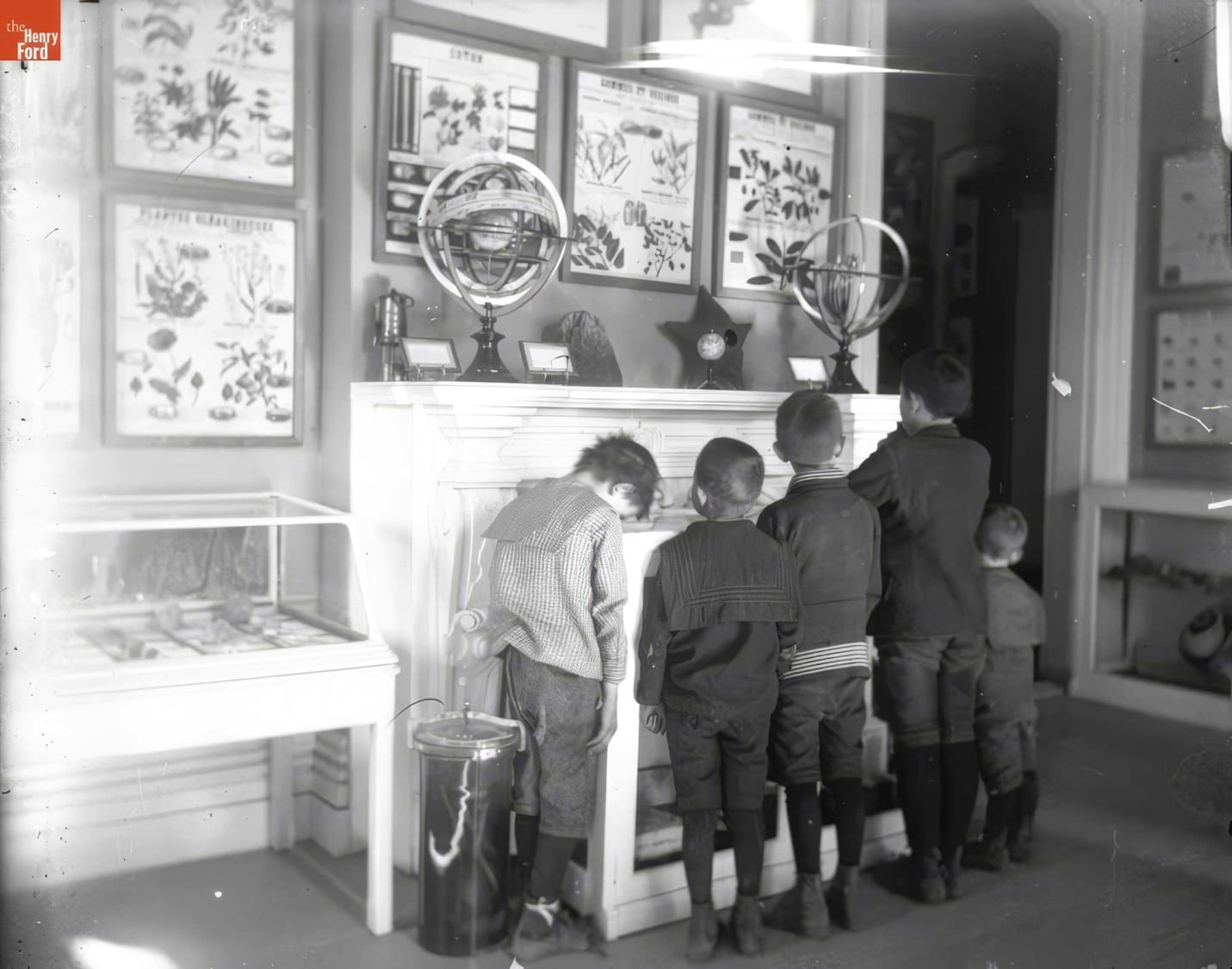
Fig. 2. Boys in Brooklyn Children’s Museum, 1899–1915. Photograph by Jenny Young Chandler. From the Collections of The Henry Ford. Gift of Betty R. K. Pierce.
Just as anxiety about how adults spent their recreational hours informed the relationship between the South Kensington and its audience, concern over children’s recreation played into the pedagogy of the Brooklyn Museum. The museum offered supervised indoor recreation outside of school hours, which support one of the museum’s key objectives, which Gallup described as providing “new subjects of thought for pursuit in leisure hours.”[25] She contrasted the atmosphere of the “cheerful, sunny, attractive museum” with the “demoralizing influence of crowded city streets and back alleys” and argued that the museum should be appreciated in light of “the influence for good or evil of habits acquired in leisure hours.”[26] This mindset reflects her historical moment and milieu, as Gallup would have been informed by reformer projects to keep children off the street, safely indoors, and away from influences that might render them delinquent.
The Brooklyn Children’s Museum also set out to shape children’s tastes and even ideas about their cultural identities. Echoing the concerns of art museums for adults, the art room was intended to “arouse a refinement of appreciation for the best religious and dramatic images,” thus developing children’s taste and directing them toward what was considered appropriate subject matter.[27] In the history room children found models and miniature scenes depicting life in colonial America, including dolls in period dress that they could play with. By inviting children to role-play as British colonists, the museum was essentially instructing them to inhabit and internalize the origins of the colonial, white American. In early twentieth-century Brooklyn, the children visiting the museum likely represented a mix of immigrant backgrounds, so this kind of play—drawing children into a particular origin story for America—aligned with the cultural assimilation efforts that characterized social reform movements of the moment.[28]
A slightly later counterexample in museum pedagogy is the Newark Museum, founded in 1909 and led in its early years by John Cotton Dana. Dana was a visionary in advancing public access in museums, creating lending libraries of artworks, mounting exhibitions of everyday objects, and training teachers to instruct in visual literacy.[29] He was committed not only to self-directed and hands-on learning for children but also to granting them real agency in the museum. In his text The New Museum from 1917, as one point on a list of “Fundamental Notes” for museums, he states, “Encourage the young to help make their museum.”[30] This edict can be seen in action with the Homelands exhibition from 1916, where the museum invited children from sixteen local schools to collect textiles that their parents had brought with them when they immigrated to the United States.[31] The array of global craft practices that arrived via the children was far richer and more varied than what the museum could collect through its own resources. A selection of them was put on display and thus reflected the community back to itself, valorizing the cultural diversity of the local immigrant population. Children were given real agency in sourcing the material for the exhibition and were encouraged to value their own cultural heritage. Here we see self-directed pedagogical methods similar to those that were in place at the Brooklyn Children’s Museum. Yet children were granted agency over not just their play but also real museum functions at the Newark Museum, and they were invited to shape the narratives on view rather than remain confined to those deemed appropriate by curators and educators.
The model for museum pedagogy led by Gallup at the Brooklyn Children’s Museum had a significant influence. It was followed by a number of children’s museums or museum wings that opened across the US in the first decades of the twentieth century, and Gallup was a respected expert in her field, remaining at the helm of the Brooklyn Children’s Museum until 1937.[32] In 1907 she was one of five women to attend and present at the second American Association of Museums meeting in Pittsburgh. And by 1908 the Brooklyn Children’s Museum had, in her words, “awakened in this and foreign countries an interest in new lines of educational advancement suggestive of greater possibilities.”[33] Those “greater possibilities” imagined by Gallup can be found in children’s museums and wings today. While the language of museum pedagogy has changed, the central tenets remain: self-directed and motivated learning, interactive materials, the use of the senses, and the stimulation of the imagination through play.
By looking back to the turn of the twentieth century, we see how art museums defined aspects of their civic and social responsibilities in relation to newly developing conceptions of childhood. Museums invested in the understanding of children as innocent and in need of protection from falling into delinquency. They positioned children as key to projects of “civilizing” and assimilating working-class and immigrant populations. And they were testing grounds for progressive education—providing important outlets for children to exert autonomy in their learning. Here we see the beginnings of an enduring tension in art museums: On the one hand, museum pedagogy argues for children’s freedom to direct their own learning, follow their own interests, and engage directly with creative materials and processes. On the other hand, art museums are often themselves institutions that police behavior and subject visitors to surveillance and control.
In the next section I jump forward in the twentieth century to the 1960s and ’70s, when American museums faced protests over the long-standing racial exclusion and racism of their practices. I focus specifically on the MoMA and the founding of the Studio Museum in Harlem. Building on the idea that children have been key figures in museums’ social reform ambitions, I narrate their outsize presence and influence during this period, when the question of who museums are for was under significant pressure.
It is often through children that art museums experiment with reaching new demographics of visitors. Recall, for example, how Henry Cole, the director of the South Kensington in the late nineteenth century, saw children as key to making the museum a morally uplifting activity for working-class visitors who were new to attending exhibitions. Similar dynamics have been at play in the US, as museums have attempted, over the second half of the twentieth century and up to the present, to reach larger audiences of color, particularly Black and Latinx audiences. Children’s programs are often the first attempts that museums make at diversifying their audiences. To explore this particular role that children play in art museums, I take as a case study the MoMA in New York in the late 1960s, as well as the founding of the Studio Museum in Harlem during that time. This period, when MoMA in particular and museums in general were subject to scrutiny and protest from artists over racial exclusion, is valuable for understanding how museums relate to their audiences today. Children were meaningful figures in both the protest movements of that moment and in museums’ responses.
In the late 1960s MoMA was exploring how to broaden its engagement with racially diverse audiences while at the same time it was being protested by artists of color who had been systematically excluded from its collection and exhibitions. In a fundraising letter from 1968, a staff member wrote that the museum shared “the Nation’s increasing concern for the people who live in the ghetto areas” and it had “long been seeking new ways to extend some of its activities effectively into Harlem.”[34] It found this extension most directly through a children’s program, the Children’s Art Carnival in Harlem, which it established in 1969. MoMA and the figures both inside and outside the museum who were involved in the establishment of Children’s Art Carnival were also key players in the establishment of the Studio Museum in 1968, the first museum in the US founded to show the work of African Americans alongside artists of all other backgrounds.
A key figure in the founding of both institutions was the painter and educator Betty Blayton-Taylor.[35] Notably for my interests she came to advance both projects through her work with youth. In her book Mounting Frustrations: The Art Museum in the Age of Black Power, Susan E. Cahan describes how Blayton-Taylor came to play such an important role in the founding of the Studio Museum.[36] Blayton-Taylor studied education and psychology at City College of New York and there heard about Harlem Youth Opportunities Unlimited (HARYOU), the social activism organization that created work and education opportunities for teenagers in Harlem. At that time the program was being developed by the social psychologist and City College professor Kenneth B. Clark. Clark and his wife, fellow psychologist Mamie Phipps Clark, had conducted the famous “Doll Study,” which demonstrated the deleterious effects of segregation on Black children, and they acted as expert witnesses in the 1954 Brown v. Board of Education case that ended school segregation. With HARYOU they conducted extensive sociological research on life in Harlem and developed both practical programs to empower young people and a larger theory of how community action led by residents could build and sustain the neighborhood’s infrastructure and cultural life.
By the mid-1960s Blayton-Taylor was teaching in HARYOU’s art program when she began bringing her students from Harlem to visit MoMA. She was friends with the poet Frank O’Hara, who worked as an associate curator at the museum, and he would make sure that the young people were welcomed by security staff, who were not used to seeing groups of Black teenagers visiting. The museum embraced these visits, and staff began to organize discussions for the young people, some featuring prominent artists. Its Junior Council of donors got involved, and Blayton-Taylor began discussing with them the fact that there was no museum in these students’ own neighborhood. It was in these discussions that the idea for the founding of the Studio Museum began to develop.[37] HARYOU youth participants were involved in building community support for the new museum, canvasing in Harlem and speaking with social groups and churches. The museum opened in 1968. Its longer history is important to understanding developments in contemporary art and the politics of racial representation in museums but is outside of the scope of this article.[38]
While MoMA council members had been involved in the founding of the Studio Museum, it was not a project of the museum. The Children’s Art Carnival, however, was (fig. 3). The program was first developed in 1942 by MoMA’s Director of Education, Victor D’Amico, on-site at MoMA. The relocation to Harlem was the first instance when the museum took its activities beyond 53rd St. The Carnival was first housed in the Harlem School of the Arts on St. Nicholas Avenue at 141st Street, where its mission was, in Blayton-Taylor’s words, to “introduce children to creative activity.”[39] After five years it was incorporated as an independent community-based art institution and moved to a dedicated home nearby. Blayton-Taylor remained the director until 1998.

Fig. 3. Children standing with Betty Blayton-Taylor (top, center) at the entrance to the Children’s Art Carnival at the Harlem School of the Arts, ca. 1969–1970.
Blayton-Taylor described the founding of the Harlem Children’s Art Carnival as an explicit response from MoMA to external pressures to be responsive to racial and class difference: “This was during the period of what I call ‘the Frankenstein Negroes,’ who were all kinds of monsters saying what was supposed to be happening.”[40] Her shocking comment anticipates critiques of museum education programs focused on Black children. Cahan articulates the racism underlying this focus on youth education and is worth quoting at length:
The myopic focus on education, which has become permanently installed as a fixture in the museum field since the 1970s, was a substitute for radical transformation of curatorial practices and a placeholder for egalitarian hiring. The idea that audiences who had been discriminated against and excluded would now be invited inside under carefully managed and monitored conditions—as subjects of the museum’s tutelage, under the watchful eye of museum officials—suggests a form of social management rooted in ignorance and fear.[41]
Education programs for children of color are deemed easy entry points into diversifying audiences and can be used by museums to divert critical attention away from more structural change. I see it as no accident that children’s programming is often the first area where art museums attempt to expand their audiences. Art programming for children is assumed to be unquestionably good and the cultural association of children and innocence seemingly renders them nonthreatening and nonpolitical. Children are therefore understood as an uncomplicated subset of potential Black and Latinx audiences who will not push back against the institution.
Art museums’ focus on children to reach new racial demographics also evokes the paternalistic infantilization of Black people. Scholar Toby Rollo argues that this association perpetuates racial violence: “Black peoples, especially youth, are exposed to violence precisely because they are viewed as children.”[42] He points to how the designation of “child” creates “a site of naturalized criminality, violence, and servitude, to which black peoples are principally relegated.”[43] The dynamics that he identifies echo the associations between childhood and delinquency that arose in the early twentieth century and were discussed in the first section of this essay.[44] Following Rollo’s argument Black children become associated with delinquency, and this association is then also applied to Black adults. When art museums principally interface with communities of color through their children, they risk perpetuating these racist associations rather than granting real agency to Black people of all ages within institutions—including artists, curators, visitors, donors, and children themselves.
Artists and activists during the 1960s and ’70s understood children as central to their struggle for racial representation in art museums. MoMA was under pressure from the Art Workers’ Coalition, an activist group founded by artists in 1969, to make art institutions more equitable and accountable, emphasizing class solidarity between artists and other kinds of workers. They focused specifically on MoMA because of its wealth and influence. Within the multiracial coalition that was the Art Workers’ Coalition, artists of color worked to advance issues of racial equity (fig. 4).[45]
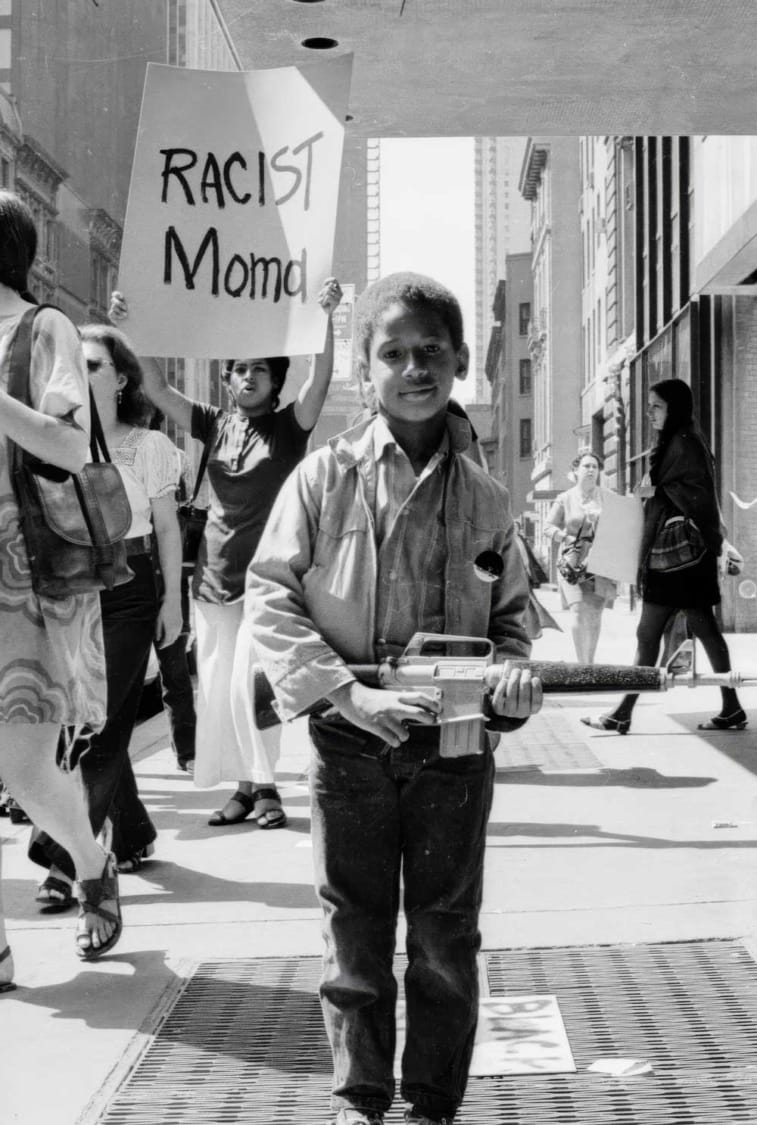
Fig. 4. Artist Tom Lloyd’s son at the Art Workers’ Coalition and Black Emergency Cultural Coalition protest at MoMA, May 2, 1970. Photograph by Jan Van Raay.
In a 1969 pamphlet promoting a rally at MoMA, artists Faith Ringgold, Tom Lloyd, and Raphael Montañez Ortiz used the education of children as a key argument in their case to racially integrate the museum:
The differentness of other Americans is recorded and preserved in the art of their group; their children and our children see it, and this fosters identification and a sense of worthwhileness. Our children and we ourselves are entitled to this same identification, respect, and sense of worthwhileness enjoyed by others. The public vehicle for helping to sustain and encourage all of this is the museum.[46]
Critically all three of these artists were also educators with experience working with young people, and both Ortiz and Ringgold were teachers in New York City public schools.[47]
The questions of representation and inclusion raised by artists and activists during this period remain pertinent in US museums today. By looking back to the late 1960s, we see that children and teenagers symbolized the hope for a generation raised in racially integrated institutions. This was, after all, less than twenty years after the Brown v. Board of Education Supreme Court decision that desegregated schools. The presence of the HARYOU youth at MoMA made it possible to imagine a museum that would speak directly to their cultural identities, and the subsequent founding of the Studio Museum in Harlem has had an enormous influence on generations of Black artists, curators, and educators. Children’s programs can be sites to imagine radically new ways of relating to audiences. Yet, if they are marginalized and siloed, then the presence of racially diverse children in museums will only ever be instrumentalized.
For the social reformers and progressive educators of the early twentieth century and the artist-activists of the late 1960s, children represented the future. Through their education, set and administered by adults, another vision for a better future was possible. This idea about the future is flipped in Adelita Husni-Bey’s The Council, the work with which I open this article. In Husni-Bey’s project the future is already understood as broken because of the choices that adults have made. Instead of adults protecting and directing children into the future, young people are called upon to take over and steward the art museum forward. Their agency is centered and, in fact, is understood as crucial to the longevity of our institutions.
Agency is an important concept in children’s studies and a fraught issue in mainstream cultural discourse about children. Seeing children as active social beings with their own agency was a key contribution of what was called the “New Paradigm” in sociology that emerged from the 1960s to the 1980s. Sociologists such as Allison James, Chris Jenks, and Alan Prout issued “a call for children to be understood as social actors shaping as well as shaped by their circumstances.”[48] This paradigm shift allowed for children to be understood as having opinions and ideas that could inform institutions, instead of simply being shaped by them.
During the same period ideas about children’s agency informed developments in pedagogy. Critical pedagogy, rooted in Paulo Freire’s concept of conscientização (critical consciousness), from his 1970 book Pedagogy of the Oppressed, and expanded by bell hooks and others, challenges traditional hierarchical teaching models and positions education as a practice of freedom that enables students to recognize and resist oppression.[49] Culturally responsive pedagogy, developed by Gloria Ladson-Billings in the 1990s, emphasizes using students’ cultural backgrounds and lived experiences as resources for learning.[50] Art and museum education have built on these foundations, with pedagogues like Maxine Greene arguing that arts-based education is critical for young people “to become different, to find their voices, and to play participatory and articulate parts in a community in the making.”[51]
Yet within political and educational policy, the agency of children remains contentious. For example, the 1989 UN Convention on the Rights of the Child includes an article that grants children the right to weigh in on matters that affect them:
State Parties shall assure to the child who is capable of forming his or her own views the right to express those views freely in all matters affecting the child, the views of the child being given due weight in accordance with the age and maturity of the child.
Primarily because of this single clause, and its potential to challenge adult authority, the United States has never signed on to the convention.[52]
If children are granted real agency within the institutions that structure their care and education, will the effect be in their best interest? Skeptics would question whether listening to children’s perspectives is good for them at all. Children’s choices and ideas often run counter to the structure and rationality that adults believe should underpin institutions. As James, Jenks, and Prout put it, “There is a wilfulness, even an anarchy, that the agency of childhood emits which resists containment and control through intelligibility.” While we can study children and their development, their behavior is not constant and often introduces a level of randomness to adult life.
In the context of the art museum, where behavior is heavily prescribed, what does children’s agency do? James, Jenks, and Prout point to how “children pose a potential threat or challenge to social order and its reproduction.” Museums are spaces where social order is constructed and reproduced. As Carol Duncan argues in The Museum Ritual, “to control a museum means precisely to control the representation of a community and its highest values and truths.”[53] We saw this effort to control in the social reform missions of the South Kensington Museum and the Brooklyn Children’s Museum. Yet we have also seen that when children are granted agency within the controlling context of the art museum, new ideas or possibilities emerge. The children involved in gathering textile samples at the Newark Museum facilitated a new relationship between the institution and local immigrant populations. The presence of Black teenagers from Harlem at MoMA allowed donors to imagine the value of a culturally specific museum in their own neighborhood.
In her book The Child to Come: Life after the Human Catastrophe, Rebekah Sheldon describes the child as “a kind of retronaut, a piece of the future lodged in and under the controlling influence of the present.”[54] Within museums children represent an encounter between the future and the past. They thus occupy an uncomfortable position: They are not quite the principal audience, yet they are crucial to the enduring relevance of the institution. I see the tension of children’s position within art museums as what makes their role there so vital. Their awkward position forces questioning and opens the potential for new opportunities for how museums relate to their audiences. Because they do not entirely “fit,” children have an outsize effect on museums, forcing them to bend their practices in ways that then inform the rest of the “adult” museum. As we have seen at both the beginning and the middle of the twentieth century, children’s programs have long been spaces where new ideas about what an art museum is and who it serves are worked out.
I study the history of children in museums in order to avoid the worst tendencies of institutions toward the control and instrumentalization of children. I argue that art museums should turn toward the agency granted to children through the history of progressive education movements and visionary programs like HARYOU, which not only affect the participating youth but also bring about change in institutions more broadly.
For the contemporary art museum, looking critically at the social construction of childhood also presents an opportunity to reconsider children’s contributions and position them as collaborators for artists, curators, and educators. Working with children opens a portal to new ways of behaving, relating to each other, and imagining the future within institutions. Granting children agency, like the young people in Husni-Bey’s The Council, holds our focus on the experiences of real children instead of our adult projections and fantasies about what childhood is and is not. Across the history of museums, childhood functions as a site of both control and possibility, illuminating a central tension for museums and their publics.
Alethea Rockwell assumed the role of Keith Haring Director of Education and Public Engagement at the New Museum in 2023. In this position, she leads the institution’s educational initiatives and public programs, which encompass artist residencies, programs for families, teenagers, and teachers, as well as collaborations with local organizations. Prior to this, she served as Associate Educator for Public Engagement and Artist Programs at the Museum of Modern Art and as a curatorial assistant at the Pennsylvania Academy of the Fine Arts. Rockwell holds a master’s degree from the Courtauld Institute of Art and has contributed to lectures and publications exploring the relationship between education and contemporary art.
[1] While adolescence is often separated from childhood, here I treat it as a period within childhood. For ease of reference by “childhood” and “children” I mean anyone under eighteen, despite the arbitrariness of this age cutoff. I address this question in more detail further on in the article.
[3] Duncan states that visitors’ identities (social, sexual, racial, and I would add age) are part of performing the ritual: “Those who are best prepared to perform its ritual—those who are most able to respond to its various cues—are also those whose identities [be it] social, sexual, racial [ . . . ] the museum ritual most fully confirms.” Carol Duncan, Civilizing Rituals: Inside Public Art Museums (New York: Taylor & Francis, 2005), 25.
[4] I am currently the Keith Haring Director of Education and Public Engagement at the New Museum in New York and previously spent seven years at the Museum of Modern Art.
[5] Philippe Ariès, Centuries of Childhood: A Social History of Family Life, trans. Robert Baldick (New York: Vintage Books, 1962).
[6] For an overview of the sociology of childhood, see Allison James, Chris Jenks, and Alan Prout, Theorizing Childhood (Cambridge: Polity Press, 1998)
[7] G.A. Res. 1386 (XIV), Declaration of the Rights of the Child (November 20, 1959).
[8] In her 1909 book The Century of the Child, design reformer and social theorist Ellen Key presented the universal rights and well-being of children as the defining mission of the century to come. Ellen Key, The Century of the Child (New York: G.P. Putnam’s Sons, 1909).
[9] Viviana A. Zelizer, Pricing the Priceless Child: The Changing Social Value of Children (New York: Basic Books, 1985), 3.
[10] Zelizer, Pricing the Priceless Child, 21.
[11] The idea of the child as essentially innocent can be traced to the writing of Jean-Jacques Rousseau, who opened his 1762 book Émile, or On Education with the idea that “God makes all things good; man meddles with them and they become evil.”
[12] Ruth S. True, Boyhood and Lawlessness (New York: Survey Associates, 1914).
[13] Anthony M. Platt, The Child Savers: The Invention of Delinquency (Chicago: University of Chicago Press, 1969).
[14] Platt, Child Savers, 4.
[15] Platt, Child Savers, 4.
[16] Kathryn Bond Stockton, The Queer Child, or Growing Sideways in the Twentieth Century (Durham, NC: Duke University Press, 2009), 42.
[17] See John Dewey, Democracy and Education (New York: Macmillan, 1916).
[18] Kathleen Curran, The Invention of the American Art Museum: From Craft to Kulturgeschichte, 1870–1930 (Los Angeles: Getty Research Institute, 2016).
[19] Tony Bennett, The Birth of the Museum: History, Theory, Politics (London: Routledge, 1995).
[20] For a study of the idea of “plasticity” or malleability in children, see Jules Gill-Peterson, Histories of the Transgender Child (Minneapolis: University of Minnesota Press, 2018).
[21] Bennett, Birth of the Museum, 102.
[22] Sir Henry Cole, Fifty Years of Public Work of Sir Henry Cole, K.C.B., Accounted for in his Deeds, Speeches and Writings, vol. 2 (London: George Bell and Sons, 1884), quoted in Bennett, Birth of the Museum, 21.
[23] See Curran, Invention of the American Art Museum.
[24] Anna Billings Gallup, “The Children’s Museum as an Educator,” Popular Science Monthly 72, no. 4 (April 1908), accessed December 15, 2024.
[25] Gallup, “Children’s Museum as an Educator.”
[26] Gallup, “Children’s Museum as an Educator.”
[27] “The Brooklyn Children’s Museum Does Its Work,” The New York Times, November 12, 1905 (accessed October 1, 2024).
[28] We do not know the racial demographics of the Children’s Museum’s audience, but The New York Times does report on one Black boy who had been attending the museum. Gallup may have been particularly sensitive to the education of Black children as she had previously taught at Hampton Agricultural and Industrial School, a school for Black students in Virginia famously attended by Booker T. Washington. “Brooklyn Children’s Museum.”
[29] See Carol G. Duncan, A Matter of Class: John Cotton Dana, Progressive Reform, and the Newark Museum (London: Prestel, 2009).
[30] John Cotton Dana, The New Museum: Selected Writings by John Cotton Dana, ed. William A. Peniston (Washington, DC: American Association of Museums, 1999), 43.
[31] Dana, New Museum, 161.
[32] Other early children’s museums in the US are the Boston Children’s Museum (1913), the Children’s Museum of Detroit Public Schools (1915), and the Children’s Museum of Indianapolis (1925).
[33] Gallup, “Children’s Museum as an Educator.”
[34] Charles T. Hesse to C. Raymond Hulsart, July 17, 1968, VDA, IV.A.v.2, quoted in Darby English, Among Others: Blackness at MoMA (New York: Museum of Modern Art, 2019), 49.
[35] It is worth noting that studying children in art museums also highlights the often hidden work done by women to advance the field over the course of the twentieth century: both Ann Billings Gallup in the first section of this article and Betty Blayton-Taylor.
[36] Susan E. Cahan, Mounting Frustration: The Art Museum in the Age of Black Power (Durham, NC: Duke University Press, 2016).
[37] Susan E. Cahan provides a helpful discussion about terms such as “community based” and “culturally specific,” which are used to describe museums created in specific neighborhoods to reflect the culture of the people who live there. Cahan, Mounting Frustration, 20.
[38] See Cahan, Mounting Frustration; Thelma Golden, Connie H. Choi, and Kellie Jones, Black Refractions: Highlights from The Studio Museum in Harlem (New York: Rizzoli Electa, 2019); Crystal A. Britton (ed.), The Studio Museum in Harlem: 25 Years of African-American Art (New York: The Studio Museum in Harlem, 1994); Bridget R. Cooks, Exhibiting Blackness: African Americans and the American Art Museum (Amherst: University of Massachusetts Press, 2011).
[39] Blayton-Taylor, quoted in Stephen N. Lockett, “‘Five’ Is All about Five,” Amsterdam News, August 28, 1971, PI, II.A.491, quoted in English, Among Others, 50.
[40] Blayton-Taylor, in an interview with Halima Taha, November 9, 1997, in Artist and Influence: The Journal of Black American Cultural History XVII (New York: Hatch-Billops Collection, 1998): 52, quoted in English, Among Others, 49.
[41] Cahan, Mounting Frustration, 261.
[42] Toby Rollo, “The Color of Childhood: The Role of the Child/Human Binary in the Production of Anti-Black Racism,” Journal of Black Studies 49, no. 4 (2018): 307–29.
[43] Rollo, “Color of Childhood.”
[44] Here Stockton’s definition of delinquency is helpful: “a ‘delinquent,’ a pre-criminal person, who must be protected from his own propensities and from the environment that could set them off.” Stockton, Queer Child, 41.
[45] For more on the Art Workers Coalition, see Julia Bryan-Wilson, Art Workers: Radical Practice in the Vietnam War Era (Berkeley: University of California Press, 2011).
[46] Students and Artists United for a Martin Luther King, Jr. Wing for Black and Puerto Rican Art at the Museum of Modern Art in New York City (1969), reprinted in Art Workers’ Coalition, Documents / Open Hearing, n.p., quoted in Cahan, Mounting Frustration, 182–83.
[47] For more on Ringgold’s engagement with children, see Julia Bryan-Wilson, “For a Children’s Revolution,” in Faith Ringgold: American People, ed. Massimiliano Gioni and Gary Carrion-Murayari (New York: New Museum and Phaidon Press, 2022), 86–91.
[48] Allison James, Chris Jenks, and Alan Prout, Theorizing Childhood (Cambridge: Polity Press, 1998).
[49] See Paulo Freire, Pedagogy of the Oppressed, trans. Myra Bergman Ramos (New York: Herder and Herder, 1970); bell hooks, Teaching to Transgress: Education as the Practice of Freedom (New York: Routledge, 1994).
[50] Gloria Ladson-Billings, “Toward a Theory of Culturally Relevant Pedagogy,” American Educational Research Journal 32, no. 3 (1995): 465–91.
[51] Maxine Greene, Releasing the Imagination: Essays on Education, the Arts, and Social Change (San Francisco: Jossey-Bass, 1995), 132.
[52] Laura Lundy, “‘Voice’ Is Not Enough: Conceptualising Article 12 of the United Nations Convention on the Rights of the Child,” British Educational Research Journal 33, no. 6 (2007): 927–42, https://www.doi/10.1080/01411920701657033.
[53] Carol Duncan, Civilizing Rituals: Inside Public Art Museums (London: Routledge, 1995),101–102.
[54] Rebekah Sheldon, The Child to Come: Life after the Human Catastrophe (Minneapolis: University of Minnesota Press, 2016), 4.