Follow a manual added link
Stedelijk Studies Journal Issue #15
Digging up the Foundations
by Renzo Martens

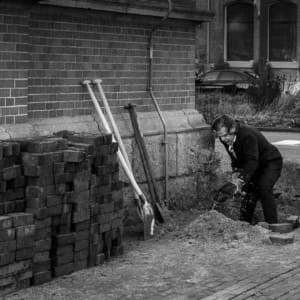
Renzo Martens digs up one corner of the Stedelijk Museum Amsterdam, 30 November 2024.
Renzo Martens:
This morning, under the watchful eyes of Ced’art Tamasala and fellow members of CATPC, Mbuku Kimpala and Matthieu Kasiama, I excavated a corner of the Stedelijk’s foundation. I did so to unearth a possible future for the museum. Let me explain.
In 1969, Dutch artist Jan Dibbets dug four trenches, each approximately one meter deep, at each of the four corners of the Stedelijk.[1]
Called Museumsokkel met 4 hoeken van 90o (Museum Pedestal with 4 Angles of 90o), the action was a key contribution to the museum’s 1969 exhibition Op losse schroeven: situaties en cryptostructuren (loosely translated as, On Loose Screws: Situations and Cryptosculptures).

Jan Dibbets, Museumsokkel met 4 hoeken van 90o (Museum Pedestal with 4 Angles of 90o), Stedelijk Museum Amsterdam, 1969.
More than fifty years on, the show is still credited with transforming the Stedelijk into a global center of pioneering and experimental art. In exposing the museum’s four corners, Dibbets aimed to raise the entire building onto a pedestal, thus elevating it to the status of an artwork.[2] By unearthing the building’s foundations, Dibbets intended to put the definition of art—intended to put the entire museum—into question. Today we take up the shovel and continue where he left off.
The Stedelijk is struggling under increasing pressure. In both visitor numbers and online traffic, it is now surpassed by the Moco Museum next door.[3] The Stedelijk claims that it is on a path toward greater justice[4] and inclusion. Yet these statistics show that a good segment of the Dutch population does not feel welcome in its galleries.
I propose that, if the Stedelijk were to excavate its past in earnest, it could recuperate its missing audiences. In reconnecting or connecting with them, it could become the visionary museum for groundbreaking art it once was. It could also, for the first time, become a museum truly by and for the people.
As artist Timo Demollin’s research, presented here at the museum in 2020, disclosed, the Stedelijk was constructed on the very grounds of the 1883 International Colonial and Export Trade Exhibition, the first international exhibition in which 28 nations showcased their colonial conquests.[5]
Further recent research—notably a publication by Laura van Hasselt[6] and the 2024 exhibition ‘Het Amsterdam van Piet van Eeghen’ in the Amsterdam Museum[7]—reveals that the Van Eeghen family, the main benefactors behind the construction of the Stedelijk Museum, earned their wealth from colonial exports, namely cocoa, coffee, and tobacco, grown mainly on plantations located in Indonesia.
It is well documented that Dutch colonial plantations in Indonesia and elsewhere were predicated on environmental and economic destruction. Rainforests were decimated and replaced by monoculture plantations where people were forced to work for scant pay. The historian Nancy Jouwe wrote in Stedelijk Studies in 2021:
[The Van Eeghen’s] profits were made at the cost of countless enslaved people and indentured laborers, wherein indigenous livelihoods and environments were disrupted. Yet…these elite families gave back lavishly to their city, thus building and contributing to a “modern, imperial” Amsterdam. The Stedelijk Museum is a prime example.[8]
Less documented but equally significant is that the Van Eeghen’s wealth did not derive from selling coffee or tobacco alone but from speculation on future profits from these commodities —and future plantations. The Van Eeghens and other funders of the Stedelijk converted plantations and coerced plantation labor—from Indonesia to the African continent—into financialized products.[9] They were instrumental in bringing plantations to the market, which could then be speculated on and traded on the Amsterdam stock exchange.
Let this sink in. The Stedelijk Museum—every stone of it—was paid for not just with profits from plantations existing at the time but with speculation on future profits from future plantations and future coerced labor. The museum was founded and paid for on the promise of perpetuated exploitation.

Plantation workers in Tanzania, ca. 1950-1955, Van Eeghen photo album, Amsterdam City Archive, object nr. 10480.
The Stedelijk is not alone. Tate Modern in London, the Van Abbemuseum in Eindhoven, the Ludwig Museum in Cologne: each of these centers of modern and contemporary art has been paid for, at least in part, by profits from plantation labor and speculation on future profits of plantation labor.[10]
Museums were built from extracted wealth, but they were also, as Jouwe points out, from their inception, established to “give back” to the world. Yet these reparations were distributed to the wrong people, inhabiting the wrong geography: compensation for profits made from the plantation system were offered to art lovers in Amsterdam instead of plantation workers in Indonesia.
In 2020, the Stedelijk made a public statement acknowledging its longstanding racism, sexism, and exclusion and[11] identifying two goals to begin making amends: First, museum leadership promised that, over the following four years, the museum would dedicate at least half of its acquisition budget to works by artists of color or to artists with an origin outside Western Europe or North America. Second, at least once a year, the museum would host “either a large solo exhibition by a non-Western (i.e. not Western European or North American) artist and/or an artist of color or a thematic group exhibition focusing on diasporas that have emerged from Dutch colonial and economic actions and who have historically been marginalized within the art world.”[12]
These declarations were great and they were long overdue. Yet, now, four years later, we are able to see the limitations of these efforts. Why, after all this time, have some of the museum’s most important stakeholders not been invited to the table? Until today, no one living and working on plantations has been invited to partake in any exhibition or discussion.
Nor has any director of the Stedelijk visited these plantations. Not Rein Wolfs, not Beatrix Ruf, not Ann Goldstein, not Rudi Fuchs. No Stedelijk curator has visited these communities either.[13] Never has anyone who runs this institution gone to see what these communities think of art, never asked them how they relate to art, to life, or to the museum.
Many other people, artists from all walks of life and geographies, have been asked these questions and invited to share their vision, but never those living and working on plantations.
Here again the Stedelijk is not alone. A few years ago, I asked the late Kasper König if he had ever visited any of the cocoa plantations that funded the Ludwig Museum and its collections.[14] He had not. I suggested to Chris Dercon[15] that he visit the Unilever plantations that co-financed the Unilever Series he curated at Tate Modern. He never replied. Even former director of the Van Abbemuseum Charles Esche has yet to visit the plantations that funded that museum.[16]
Just to be sure there is no confusion: these plantations still exist. There are more of them than ever.[17] Many of the coffee plantations that financed the Stedelijk are still coffee plantations. Many of the tobacco plantations that financed the Van Abbemuseum are still plantations too, albeit now growing palm for international corporations. Plantations in Congo, where workers make less than a US dollar per day, still supply Unilever brands.[18] [19]
Just fifteen kilometers from the Stedelijk stands one of the largest depositories of scantly paid and bonded labor in the world: the Amsterdam cocoa port.[20] The people whose labor is held in the Amsterdam cocoa port are still making good on the profits the Van Eeghens and companies like Unilever promised shareholders all those years ago.
And yet, these communities, whose lives and fates are so intimately intertwined with the museum’s, these living witnesses to the ongoing repercussions of the plantation system, the collapse of ecosystems, climate change, inequality, and the rise of authoritarian regimes, who would have so much to tell us, are not here. They are not represented on the museum’s walls. Their names are not among the sponsors and patrons honored on plaques as benefactors. Tonight, they are not in this audience. They live on plantations.
While the Stedelijk has worked for four years toward justice and building a new reputation as a center for inclusivity and diversity, in limiting the scope of that inclusivity and diversity to a few shows and acquisitions by artists handpicked by the curators, the museum continues to obscure the institution’s deeper contradictions. It renders invisible its involvement in the deeper challenges of our time.
In so far as the Stedelijjk wants to foreground inclusivity and diversity, this museum, like others, believes it can make shows “about” things. It can make an exhibition “about” colonialism, “about” climate change, “about” care, or “about” healing, without actually actively caring or healing. This is what philosopher Olúfẹ́mi O. Táíwò has coined the “elite capture” of social justice.[21] A small subset of individuals are invited—carefully selected by curators—into a room from which they were previously excluded and tasked to stand in for a larger group interest. Meanwhile, the larger group remains excluded. Their conditions remain fundamentally unchanged. They continue working on plantations.
I strongly applaud the Black artists and artists of color who have finally been invited to the Stedelijk, however restricted their access may be. Yet these initiatives put artists in the position of having to “help” the Stedelijk reach its stated goals and atone for its past, while the museum itself refuses to excavate its own foundations and take responsibility for what it unearths. To paraphrase Táíwò, artists are asked to carry the burden that the museum should carry. The artists are lifted onto a false pedestal while the museum hides itself and takes refuge below.[22]
Can the Stedelijk Museum claim to be on a path toward greater justice if many of the descendants of the very people who underwrote its foundation still work on monoculture plantations and have never been told that such a museum exists? Can the Stedelijk claim to be be interested in art if not one museum director has ever visited them, or asked them how they see life, art, the future?
What is the museum’s implicit message to these communities? We hear you? We care? Or is it quite the contrary?
Thank you for giving me the floor.
My name is Ced’art Tamasala. I am not alone, I am accompanied by my colleagues here in this room today, Matthieu Kasiama and Mbuku Kimpala.
Together, we represent our artist collective CATPC, the Cercle d’Art des Travailleurs de Plantation Congolaise (Congolese Plantation Workers Art League), based in Lusanga in the Democratic Republic of Congo. Our collective is made up of men and women, young and old.
For the past ten years, we have been making art, and this art has been exhibited in museums around the world. The income from this art has enabled us to buy back our land and plant various crops on it.
In a coalition that goes beyond the colonial difference, we succeeded in building our museum, the White Cube, in the middle of our sacred forest. We then put our White Cube on trial, and it was found guilty, as guilty as all the other museums around the world that were built with wealth extracted from forced labor.
Our plantation in Lusanga has been used by Unilever to extract profits that have financed museums and international exhibitions in England, from the Lady Lever Gallery in Liverpool to the Unilever Series at Tate Modern.
A few months ago in Venice, when we inaugurated the Dutch pavilion of the 60th Venice Biennale, we paid a respectful and grateful tribute to the plantation workers in Indonesia and Suriname who made it possible to build museums in the Netherlands.[23]
Very recently, we went to meet one of these communities in Maduarjo, East Java to forge a relationship and pay tribute to them in person. The conversations that unfolded were documented in the short video CATPC on One of the Plantations That Funded the Stedelijk Museum.

Still from: CATPC on One of the Plantations That Funded the Stedelijk Museum, CATPC and Human Activities, video, 2024.
Sugeng Rianto: “Our friends from Congo just said that they will speak at the Stedelijk Museum. If possible, can you tell them: You are standing inside a museum that was built off of the labor of our ancestors in Maduarjo and show them our coffee?”
Ced’art Tamasala: “It’s great to sell them coffee. But we can also tell our stories through the products we produce, in the form of art. In our sculptures, for example, there is palm oil, cocoa, there is also sugar. All are plantation products. We can push our imagination further. Innovating and telling our own stories of the plantation and bringing them into the museum.”
Matthieu Kasiama: “If we had limited ourselves to producing and selling palm oil, we would not be here with you to talk and exchange. Art gives you access to different emotions and different options. Making art, that’s our entryway into museums. It also allows us to declare our rights.”
Kasiama: “The people of the museum, the curator, the director of the museum did they ever come here to see, or ask, if you were making art? Did they come here, like we now do? Did anyone ever come?”
Pak Sa’i: “So, my answer is just one thing. Never once have any guests come and told us that a museum was built from the earnings here. It has never happened. Usually, people just come to see our coffee. Then it gets marketed. That’s it.”
Ced’art Tamasala: “In this moment, we can say that the [Stedelijk’s] foundational stone…is located right here with you in your village, in your home. Because everything that helped build this museum came from here. From your ancestors and yourself. The foundation of the Stedelijk, in the Netherlands, is actually here.”

Still from: CATPC on One of the Plantations That Funded the Stedelijk Museum, CATPC and Human Activities, video, 2024.
Pak Sa’i: “I understand your apologies. This museum’s dignity is low. Let’s rise together. In the Netherlands, let’s elevate [the Stedelijk’s] dignity so it is no longer low. By elevating the dignity of the museum, we hope that we can have some of that dignity too.”
Finally, I would like to make a request. On behalf of our friends from Maduarjo, whom we’ve been asked to represent today, we invite the directors, curators, and managers of the Stedelijk to take their first step toward the communities on these plantations. Only together can we succeed in including everyone, in including those who involuntarely built and financed the construction of museums in the Netherlands and around the world. This will considerably raise the dignity of museums.
I thank you.[24]
Renzo Martens:
Jan Dibbets, the artist who dug up the Stedelijk’s foundations in 1969, recently sent an open letter to the Dutch daily NRC Handelsblad criticizing the museum. In this letter, he echoed an opinion that is becoming increasingly widespread. According to Dibbets, the Stedelijk is “squandering our own heritage” and reneging on its task of showing “freedom-seeking and idiosyncratic art.” In the name of “inclusivity and diversity,” the Stedelijk has become “a narrow-minded anthropological museum.”[25]
Rather than merely dismiss Dibbets’ vitriolic assertions, I would like to briefly consider a few of the historical and political circumstances that may have lead him to make such claims and how they have come to pit people of white Dutch descent against migrants and people of color,
Fact: The museum that Dibbets wanted “to put on a pedestal” and “elevate to the status of an artwork” with his 1969 performance Museumsokkel met 4 hoeken van 90o (Museum Pedestal with 4 Angles of 90o), was funded by plantation workers in Indonesia and the African continent. Yet, the museum has never acknowledged these communities as inextricably part of “our own heritage.” The Stedelijk never told Dibbets—nor any of us—the truth about those museum foundations he dug up.
Had Dibbets been informed—had Dibbets asked—he probably would have agreed that these communities are owed their rightful place in the museum, not out of ideas of inclusivity or diversity, not because of anything “small minded” or “anthropolgical,” and certainly not because of a tokenized identity as non-Western persons of color—even if, at heart, these can be valid and laudable reasons—but because they paid for this museum. In fact, this might be an instance in which the Dutch adagium “Wie betaalt, bepaalt” (The one who pays, also decides), might actually make sense.
One could argue that many of the landmarks that helped transform Amsterdam into an ‘Imperial city,’ and later a haven for the avant garde, were paid for by plantation labor. For example, the Van Eeghen family not only funded buildings, they also contributed to the establishment of the Vondelpark. However, unlike a railway station or a city park, a modernist museum is the one place where objects—including the museum itself—can reflect on their own conditions, on their own materiality.
In any case, Dibbets’ assertion that the Stedelijk should show ‘freedom-seeking and idiosyncratic art’ cannot possibly be an objection to inviting plantation worker communities to claim their rightfull place.The Stedelijk became renowned precisely because it was one of the first museums to legitimize that stones gathered on a walk and laid in a row could be art.

Richard Long, Bluestone Circle, 1978, 14.5 x 486cm. Collection: Stedelijk Museum Amsterdam
Because the absence of art, or art in the negative form, could be art.

Bruce Nauman, A Cast of the Space Under My Chair (1965-8). Collection: Kroller Muller Museum, Otterlo.
Because digging up trenches around a museum could be art.
Jan Dibbets, Museumsokkel met 4 hoeken van 90o (Museum Pedestal with 4 Angles of 90o), Stedelijk Museum Amsterdam, 1969.
Certainly, this did not become art overnight. Curators of the Stedelijk and other museums have expended tremendous brainpower and cultural capital to justify to large audiences that such interventions can be considered legitimate art. If all this can be art, I would find it hard to believe, then, that the work of plantation workers cannot be considered art.
CATPC and other communities living and working on plantations have cosmologies and conceptions of artistic practice that go well beyond the confines of modernism. Yet, perhaps, in the minds of curators, the worldviews of these communities at the frontlines of global warming, rising inequality, and collapsing ecosystems are not valid or interesting. Perhaps because their historical art was looted, perhaps because their work leaves little time for artistic reflection, perhaps because they don’t have the rarified skills or contacts or money to get accepted into a preparatory school like the Rijksakademie.[26] No matter. It should be the core business of Stedelijk curators now to expend their brainpower and cultural capital making sure that the contributions of plantation workers are legitimized. If for no other reason than that this museum would not have existed without them.
This is not just about plantation workers. Working class communities do not feel they belong in the Stedelijk. In another essay published in Stedelijk Studies, curator Jelle Bouwhuis explains that, throughout its history, the Stedelijk held annual exhibitions of local artists and craft collectives. While ascending as a curator, Willem Sandberg did not just paint the walls white and turn the museum into a modernist cube. He transformed the Stedelijk from a place where local associations could show their work into a system in which directors and curators could handpick what they deemed the most deserving art and artists.[27] Including Dibbets. The very last annual exhibition of local artists’ associations took place in 1991. From that point on, only curators, not communities, could decide whose art was worthy to be seen in the museum.
As I have argued, plantation workers financed the Stedelijk’s every brick. But someone else laid those bricks. Someone else laid the foundations. Local Dutch dock workers carried the colonial goods ashore. Masons, carpenters, plasterers, and painters erected the building—and later painted its walls white. People who migrated from the countryside to work in Amsterdam. People whose descendants may still live in Amsterdam, or in Purmerend or Almere.[28]
The question is, do the grandchildren of those dock workers, or do contemporary dock workers, come to the Stedelijk? The visitor numbers suggest they do not and that, if they do visit a museum, many would rather go to Moco.
In a top-down model in which only directors and curators determine what is art, the Stedelijk tries to compete with the Moco Museum—a place to take selfies and capture oneself beside a certain type of celebrity art—by programming so-called blockbusters, often traveling exhibitions organized by other museums. It seems that turning the Stedelijk into a subdivision of Tate or another museum titan is the only path it sees to bringing in larger audiences.
And yet, there is another way. The Stedelijk has always claimed to be radical, and and it is time for it to once again make some radical choices.
It is time that the Stedelijk reckon with its origins and invite all those who have contributed to its foundations and to its construction to claim an equal stake in its future. The museum should no longer deny the involuntary and forced contributions of its past, thereby no longer sabotaging potential meetings and potential solidarities in the present between plantation workers and working class communities and their artistic visions.
The time has come for the museum to fully engage with its histories and bring us together.
I call for the Stedelijk to state clearly and simply: Indonesian plantation workers largely paid for the Stedelijk. Dutch workers largely built it. This is your, their, our museum too.
This acknowledgment should not happen merely with a plaque, or a thematic exhibition, but by inviting these communities, on their terms, to take part together in the future of the museum.
It is time for the museum to finally elevate all of these communities and show that the Stedelijk itself can indeed be a pedestal, for all of us, a place to show ourselves, to gather.
This is how we acknowledge the foundations of the Stedelijk. Not for a few selected artists, but for all of us. That is what the Stedelijk can do. Not just for art, but for democracy.
This is also how the Stedelijk Museum can once again become the global, freedom-seeking, cutting-edge museum it once was.
In June 2024, I was asked to give the annual Bathtub Lecture, in which a cultural producer is invited to reflect on the positioning and policies of the Stedelijk Museum.[29] I accepted the invitation on the condition that Ced’art Tamasala be invited to speak as well. In preparation for my talk, I asked whether the Stedelijk was aware of the exact plantations whose wealth was extracted for the museum’s construction. Charl Landvreugd, Head of Research and Curatorial Practice, responded that the museum was not, nor did it have any immediate plans to find out. Consulting the Amsterdam municipal archives and the University of Leiden, I and CATPC located plantations once owned by Piet Van Eeghen, one of the Stedelijk’s founding benefactors. With the collaboration of curator and artist Bunga Siagian and on-site researchers in Indonesia, it was confirmed that many of these plantations remain active today.
In November 2024, with the support of Charles Esche, former director of the Van Abbemuseum, we (Renzo Martens and CATPC members Matthieu Kasiama, Mbuku Kimpala, and Ced’art Tamasala) met Agus Evan, Lanang Adi Prayoga, Pak Sa’i, Aditya Yuda, Sujianto, Juawariyah, Sumardi, Nyamat Suyanto, Joko Wiji Santoso, and Sugeng Rianto, among others, all plantation workers and descendants of communities who financed the Stedelijk Museum. The exchanges that followed were recorded in the film screened during the lecture. As the film reveals, to truly excavate the Stedelijk’s foundations—and to put the status of the museum and modern art into question—one must look not only to Amsterdam but to a plantation in Maduarjo, Indonesia.
In 2012, Renzo Martens founded the Institute for Human Activities to investgate how he and the art world at large could meaningfully connect with the plantation worker communities whose labour and land theft they are indebted. Together with friends and colleagues, he built deep relationships of mutual care with communities of workers on former Unilever plantations in Democratic Republic of Congo, the site from which extracted profits funded the Lady Lever Gallery in Liverpool, as well as, later, the Unilever Series in Tate Modern. Martens has not shied away from exposing and even inhabiting the controversies, missteps, and contradictions, either his own or those of the systems he circulates in, to try to enact accountability.
In 2024, ten years after its inception, the Cercle d’Art des Travailleurs de Plantation Congolaise (CATPC) represented the Netherlands at the 60th Venice Biennial. This was followed by an an invitiation for a solo exhibition at the Van Abbemuseum and a collaboration with Tate Modern in 2025. In the same year, CATPC launched “Seven Easy Steps for Museums to Liberate the Plantations that Funded Them”, a pratical toolkit to help museums rethink their origins, responsibilities, and futures. In 2024 and 2025, CATPC was included in the Art Review Power Top 100, the annual ranking of the most influential people in art. Their proudest achievement is using their newfound resources to buy back their land and to regenerate the now razed sacred forest. This restored forest is owned and maintained by the community.
Now that a precedent has been established, it has become all the more evident that there is still much more to do.
[1] It is unclear whether Dibbets dug these holes himself. The photos suggest that Dibbets did the digging. In an open letter to Dutch daily NRC Handelsblad, however, the claim is made that Dibbets looked on while workers did the actual work.
[2] “Jan Dibbets in conversation with Lucy Steeds”, Afterall, 14 January 2009.
[3] In 2023 Moco Museum received 769,324 visitors, the Stedelijk 603,675 visitors. See: On 30 November 2024, Moco had 424.000 followers on Instagram, the Stedelijk 252.000 followers.
[4] “Van oudsher werd niet iedereen in gelijke mate gerepresenteerd, welkom geheten en aangesproken in het Stedelijk. Wij stellen ons ten doel om door te gaan met die trend te keren: weg van uitsluiting, richting inclusie. Weg van fysieke en mentale drempels, richting toegankelijkheid. Weg van discriminatie, richting rechtvaardigheid.” Beleidsnota: Inclusie en Toegankelijkheid in het Stedelijk, 31 March 2023.
[5] Timo Demollin, Visit (1883–2020) , 2020 in the exhibition “In the Presence of Absence” Sep 5, 2020 until Jan 31, 2021 at the Stedelijk Museum.
[6] Laura van Hasselt, Geld, geloof en goede vrienden. Piet van Eeghen en de metamorfose van Amsterdam 1816-1889. Amsterdam: Balans, 2023
[7] Het Amsterdam van Piet van Eeghen. Hoe een koopman de stad heeft veranderd. Amsterdam Museum, 29 March – 30 June 2024. Needs English translation.
[8] Nancy Jouwe, “The Stedelijk Museum in Imperial Amsterdam”, S(TEDELIJK)ZINE #1, 2022.
[9] “Tijdens het laatste kwart van de negentiende eeuw was de firma [Van Eeghen & Co.] ook nauw betrokken bij het naar de beurs brengen van talrijke plantages. Deze periode vormde het derde uitgesproken hoogtepunt in de geschiedenis van de firma.” (“During the last quarter of the 19th century, the firm [Van Eeghen & Co.] was also closely involved in bringing numerous plantations to the stock exchange. This period marked the third definite high point in the firm’s history.”) “Handelshuis Van Eeghen”, 20 February 2023, Stadsarchief Gemeente Amsterdam.
[10] Tate Modern was funded by Tate & Lyle, which held sugar cane plantations in the Caribbean. The Van Abbemuseum was funded through tobacco industrialist Van Abbe, who held plantations in Indonesia. Peter Ludwig, the founder of the Ludwig Museum in Cologne (among other Ludwig museums in Germany and Switzerland) built an empire of chocolate factories. Cocoa was first mass produced on plantations under colonial rule.
[11] The Stedelijk Commits to Fighting Racism, 11 June 2020.
[12] BELEIDSNOTA: INCLUSIE EN TOEGANKELIJKHEID IN HET STEDELIJK
[13] After the lecture, one curator of the Stedelijk stood up to say that she has an ancestor who was a contract worker in Indonesia. She regarded this a private issue, more than something to inform the program at the Stedelijk.
[14] I asked Kasper Konig, whether he had ever visited a plantation after a lecture I gave at the Kunstakademie Munster, May 24, 2016.
[15] I invited Chris Dercon, who curated Tino Seghal’s ‘These associations’ as part of the Unilever Series at Tate Modern, to visit the program that we had just started on the Unilever plantations in the D.R. Congo, but he did not reply.
[16] Charles Esche, however did initiate, facilitate and exhibit extensive research into the colonial origins of the Van Abbemuseum. He also invited CATPC to exhibit in the Van Abbemuseum, connected CATPC with Indonesian artist, curator and researcher Bunga Siagian and facilitated CATPC’s research trip to the plantations that funded the Van Abbemuseum.
[17] Human Rights Watch, A Dirty Investment. European Development Banks’ Link to Abuses in the Democratic Republic of Congo’s Palm Oil Industry, 25 November 2019 see:
[20] https://www.portofamsterdam.com/en/business/cargo-flows/cocoa
[21] Olúfẹ́mi O. Táíwò, Elite Capture: How the Powerful Took Over Identity Politics (And Everything Else), p. 107 (epub, chapter: Deference Politics) Chicago: Haymarket Books, 2022.
[22] idem, p. 173 (epub, chapter: What the Constructive Approach Asks of Us)
[23] At the opening ceremony of the exhibition ‘International Celebration of Blasphemy and the Sacred’, CATPC’s exhibition that served as the Dutch entry at the 60th edition of the Venice Biennial, Ced’art Tamasala stated: “First of all, lets start with paying a respectful tribute to the plantation workers of the past and of the present in Surinam and Indonesia, who financed the construction of museums in the Netherlands.”
[24] Original text: Merci pour la parole.
Moi c’est Ced’art Tamasala. Je ne suis pas seul, je suis accompagné par mes collègues ici, Matthieu Kasiama et Mbuku Kimpala.
Ensemble, nous représentons notre collectif d’artistes, le Cercle d’art des travailleurs de plantation congolaise basée à Lusanga en République Démocratique du Congo. Notre collectif est composé de femmes et d’hommes, de jeunes et des gens plus âgés.
Depuis dix ans, nous faisons de l’art, et cet art est exposé à travers les musées dans le monde. Les revenus de cet art nous ont permis de racheter notre terre et d’y planter diverses cultures.
Dans une coalition qui va au-delà de la différence coloniale, nous avons réussi à construire notre musée le White Cube au milieu de notre forêt sacrée. Nous avons ensuite jugé notre White Cube qui a été reconnu coupable comme les autres musées dans le monde qui ont été construits grâce aux profits extraits du travail forcé dans les plantations.
L’exemple de notre plantation a Lusanga, ou Unilever a fait des profits qui ont financé la construction des musées en Angleterre, et financé des artistes internationaux. À l’exemple de la Lady Lever Gallery à Liverpool et la Unilever Series au Tate Modern.
Il y a quelques mois à Venise, nous rendions un hommage respectueux et reconnaissant aux travailleurs de plantation en Indonésie et au Suriname, ceux et celles qui ont permis la construction des musées aux Pays Bas.
Très récemment nous sommes allés à la rencontre de ces communautés en Indonésie pour créer le lien et leur rendre hommage une fois de plus. Sans plus tarder, regardons le film de notre rencontre avec nos amis en Indonésie.
Je finirai par introduire une requête : au nom des travailleurs de plantation en Indonésie que nous représentons, nous invitons les directeurs, les curateurs et les responsables des musées à bien vouloir faire le premier pas vers les communautés dans ces plantations. Ce n’est qu’ensemble qu’on peut arriver à inclure tout le monde y compris ceux qui ont bâti et financé involontairement la construction des musées aux Pays-Bas et dans le monde. Cela permettra d’élever considerablement la dignité des musées. Je vous remercie.
[25] In an open letter published in the newspaper NRC, Dibbets agrees with a previous open letter by Jan Christiaan Braun that ends with “[…] ik ga dan ook niets bijdragen aan de verdere afbraak van dit instituut tot een antropologisch kleinstedelijk museum.” In: “Het Stedelijk wordt bestierd door moraalridders”, NRC, 29 January 2023. For Jan Dibbets’ letter see: “Kostbaar erfgoed”, NRC Handelsblad, 1 February 2023.
[26] De Rijksakademie in Amsterdam is a well-known institution, that has over the last decades hosted many artists from the Global South, who continued to persue stellar careers. This includes founding members of the Indonesian collective Ruangrupa, who went on to curate Documenta fifteen in Kassel. We have no indication that any plantation workers have ever been invited to the Rijksakademie.
[27] Jelle Bouwhuis, “Fail Better: SMBA (1993–2016) and the Limits of Institutional Critique”, Stedelijk Studies Journal Issue #13, 5 March 2024.
[28] Satellite cities of Amsterdam to which a large segment of the Amsterdam working classes moved since the 1960’s.
[29] Earlier contributors were Kader Attia and Yvette Mutumba.