Follow a manual added link
Stedelijk Studies Journal Issue #15
Lora Sariaslan interview with Bill Balaskas
for Stedelijk Studies Journal #15
Lora Sariaslan (LS): As an artist working across countries and cultural contexts, how do you think museums should address audiences with diverse and often conflicting cultural backgrounds? And how could artists and institutions respond to the additional challenges posed by the fact that their audiences are increasingly shaped by crisis—economic, environmental, political?
Bill Balaskas (BB): For any cultural practitioner working internationally and for any institution with international visitors, there is always the danger of falling victim to a rather abstract notion of a “global audience.” Quite simply, such an audience does not exist. So, instead of being led by pseudounifying intellectual and aesthetic devices, museums and artists should start from situated research. Cultural practitioners working internationally should always prioritize working with local collaborators and communities so that each project is rewritten in their terms, rather than being parachuted in as a finished script waiting to be “read” or “enacted.” Also, disagreement must be embraced as a productive condition: Museums need to be open to the prospect of designing programs where conflicting perspectives coexist in some shape or form, instead of aiming for a pseudoconsensus or a monosemous narrative. Of course, that does not mean that museums should not have strong values; on the contrary these are absolutely necessary and their expression is a key responsibility for cultural institutions. However, museums should also allow antithetical social realities to be reflected in their subjects and narratives, even when the museum’s position is to actively oppose them. To acknowledge the existence of conflicting views is not to legitimize them. Rather it can mean being even more impactful as a social agent of change through presenting a well-informed, robust position. Finally, this mode of openness also requires diversifying curatorial methodologies by using multiple points of access—for instance, different kinds of language, references, media, pace, and temporalities—so that visitors can enter exhibits through diverse lived experiences as much as through more specialist, art historical, and theoretical discourses.
Such an approach is, of course, even more important in times of crisis. If museums want to be meaningful through their work, they need to address the condition of crisis as a starting point. The building of programs—and not just stand-alone exhibitions or one-off events—should address economic precarity, the climate crisis, AI, global conflict, and so on as structuring conditions, not as occasional themes. Also, another necessity for museums is investing in infrastructures of care, particularly when it comes to their local communities. This may involve creating quiet spaces or providing different formats of translation, childcare, fair pay for local collaborators, and mental health–aware facilitation, to name a few methods. All those steps are very important for visitors who are more vulnerable, if they are to stay in the conversation that the museum is initiating or hosting. We have seen this shift to curatorial ecologies of care become more prominent over the last two decades—ever since the global financial crisis of 2008. However, I should highlight that without maintaining a self-reflective point of view, this may also become a curatorial double-edged sword, as you don’t want institutions to uncritically cover the gaps in care left by governments. This is particularly important in relation to areas like well-being, mental health, and education. Museums should not accept this “transfer of care” as a normal condition when it touches upon fundamental public services that should be provided systematically and by experts. It is very convenient for governments to make cuts while pointing to other sectors as the solution.

Figure 1. Bill Balaskas, The market will save us, 2013. Banner (Verseidag mesh supreme) on the facade of the Royal College of Art, London, 23.4 x 6.8 m. The intervention was realized with the support of Irene Y. Panagopoulos. Photo by Dominic Tschudin.
In the end I think that the most important element is that artists and museums learn to listen before defaulting to institutional norms or art-world expectations. This is why I increasingly value long-term projects: I feel that they allow artists, museums, and audiences to connect through the conditions of crisis, rather than only reproduce or consume narrations of catastrophe. For me personally this conviction has been consolidated over the last decade through the privilege of participating in intercultural dialogues with Aboriginal Elders in Tasmania and elsewhere in Australia. The learning here has been slow, patient, and explicitly non-output-driven, because the point is not visibility or achieving quick translation. I still have a great deal to learn, and I am also very conscious that what I am trying to do often requires institutional change before it can take a visible form—whether that is an artwork, an exhibition, or a public program. In the meantime, I listen, I build relationships, and I prepare.
LS: Your practice often comments on the politics of digital culture. What do you think museums (mis)understand about digital audiences?
BB: Just as the “global audience” is a convenient abstraction, the category of the “digital audience” can operate in the same way—as a pseudounifying agent. Museums often overidentify the “digital” with access, growth, or reach, and they underestimate the political economy in which digital audiences are formed. Visibility under data capitalism is not neutral—attention is governed and monetized every single moment. This is why “digital audiences” are not simply online audiences. They are publics trained by platforms where the feed defines what counts as relevant, where speed is mistaken for significance, and where agency is confused with visibility. Cultural institutions reproduce this confusion when they adopt social media not only as marketing infrastructure but also as technocultural infrastructure. That is why we increasingly see museums integrating the logic of the feed into their curatorial strategies. The promise of “endless content”—which is very much a social media promise—risks producing a situation in which the institution’s point of view becomes inaccessible or is experienced as provisional, constantly “drafted” rather than argued. In this context the digital is not merely a set of tools; it becomes a cognitive model through which audiences are trained to accumulate impressions and to mistake navigability for meaning, just like with a social media feed or timeline. The result is a gamified mode of cultural attention, where “newness” becomes an ideology and infrastructural critique is evaded because of sheer convolution. If we look at the curatorial frameworks, increasing scale, and ever-growing complexity of many mega exhibitions developed over the past two decades (biennials, triennials, documenta, etc.), this starts to become evident. In the post-truth condition, this is not a secondary issue: It questions whether cultural institutions still have the ethical authority and practical means to speak about facts, evidence, and dissent.

Figure 2. Bill Balaskas and Stop LAPD Spying Coalition, Before the Bullet Hits the Body, 2021. Ground mural (vinyl stickers) at Pedion tou Areos park, Athens, Greece, 8 x 24 m. Commissioned by the Stegi cultural centre of the Onassis Foundation, the mural presented the algorithm in the epicenter of LAPD’s racially biased predictive policing programs, which were dismantled thanks to the campaigns and legal battles presented by the Stop LAPD Spying Coalition. Curated by Irini Papadimitriou, the work was presented in the context of the exhibition You and AI: Through the Algorithmic Lens (June 24–July 25, 2021). Photos by Stelios Tzetzias.
A related misunderstanding is the assumption that online audiences want frictionless consumption. Many do not. What they lack is not content but conditions for decoding the forces defining their lives and the future of the planet. Such an exercise of decoding can only take place in spaces that slow down the feed, interrupt habituation, and expose the devices through which “what we see” becomes “what we believe.” If, as Guy Debord postulated sixty years ago, spectacle is a social relation mediated by images, then the museum should not participate in the cultural logic of data capitalism by simply manufacturing ever more “Instagrammable moments” in its premises and programs. Instead, it should build countertempos that make mediation perceptible and debatable. This is, of course, rather difficult when gamification structures digital culture. We see that reward loops, metrics of popularity, and the recognition of quantification as value are all key characteristics of this milieu. A museum that uncritically imports these logics ends up amplifying the very conditions it might otherwise aim to critique through its programs.
LS: A recurring theme in your practice is the reactivation of political agency. How can museums create conditions where audiences feel empowered rather than passive spectators?
BB: The first step in reactivating political agency is always that audiences must realize that they do have political agency. In many of my works, I try to contribute to this goal through using elements of surprise, provocation, playfulness, and, in the end, a sense of discovery, which I feel is essential in a highly saturated information environment. The second step is cultivating the desire to activate political agency—to do something with it. For museums this “something” cannot remain a metaphor. Agency has to be made legible as a real capacity that touches upon the institution’s own operations, not only the interpretation of its content.
LS: On a more specific level, your work This Sky is Your Sky in Manchester focuses on this. Can you tell a bit more about it?
BB: One of the reasons why This Sky is Your Sky (2024) mattered to me so much as a project is that its commissioning model embedded democratization as a lived experience across all its phases: from the open call to artists to discussions with the community to formulate the final proposal; then, public presentations and voting by the community, followed by a consultation process that remained open throughout the creation of the work—even if that meant periods of uncertainty and “limbo.” The key point was not the vote as a spectacle of inclusion but the vote and continuous deliberation as a visible transfer of decision-making power to the community. This was crucial given that This Sky is Your Sky was presented on the facade of the 422 Community Hub, which is in Longsight—one of Manchester’s most ethnically diverse and deprived areas, with some of the highest rates of child poverty in the UK. I think that in contexts where migration, economic hardship, and language barriers exclude audiences from decision-making, the ethics of participation are inseparable from the politics of access. So, the practical questions—what kind of language or even fonts are used in a work, who might be fluent in institutional codes, what is treated as “normal” public art practice—become structural questions about who gets to feel that they belong in a cultural space, or any kind of space for that matter. In other words the museum needs to consider where it is located—and also where it is not. What I found particularly useful about working at 422 is that it operates as a hybrid setting alongside other initiatives, which collectively produces a sense of ownership that does not “await permission.” This condition is a very important basis on which to build agency. All public institutions should consider what “permissions” they provide when thinking about how they approach their audiences.

Figure 3. Bill Balaskas, This sky is your sky, 2024. LED light installation and window films on the facade of the 422 Community Hub, Manchester, 2.6 x 1.6 m. Created through an open-ended collaboration process based on voting, consultation, deliberation, editing, and selection led by the communities of 422, this illuminated sign was curated by Or Tshuva.

Figure 4. Bill Balaskas, This sky is your sky, 2024. The photographic workshops that supported This sky is your sky were led by Photography students at Manchester Metropolitan University, and collaboratively produced the images that were presented on the window films on 422’s façade.

Figure 5. Examples of the different fonts that were considered by the 422 communities for the illuminated sign This sky is your sky.
Of course, empowerment is a fragile process. It can very easily collapse when participation remains symbolic or when its role is based on traditional art-world or art-market hierarchies. A museum can host a hundred “engagement” moments and still leave audiences with nothing to do afterward. In Longsight the work’s longer-term value was never only the illuminated facade of the building as the “final” outcome of the commission; more than anything else it was the way the project helped articulate what the space means to its communities and how togetherness and confidence become prerequisites for future action. And the other element that the project confirmed to me as a practitioner was that not all political agency looks like protest. Some of it is quiet, slow, and cumulative, where the patient labor of sustaining a place against dominant investment logics can generate cultural value on its own terms. If an institution only measures agency through visibility, scale, or immediacy, it will miss the kinds of agency that many communities actually practice or need. The task of the cultural institution is to make these forms of agency narratable within its own frameworks and hierarchies.
LS: Many of your works project speculative or alternative political futures. What futures do you imagine for museum audiences in the coming decades? And what kind of new institutional forms could emerge alongside or beyond the museum?
BB: Given the persistence of our collective uncertainties, I think that visiting a museum will increasingly mean entering ongoing inquiries about climate, technology, and democracy, rather than encountering “finished” narratives. To some extent at least this entails seeing audiences as coresearchers, which is a point of view that should push museums toward being more inclusive and making fewer assumptions about their existing audiences and, more important perhaps, their prospective audiences. “Preaching to the converted” is definitely not enough anymore, but becoming truly open and accountable in new ways may also be a struggle for many institutions. Also, talking about issues such as climate, technology, or politics will require cultural institutions to actively engage with more-than-human stakeholders: bodies of water, flora and fauna, or even data infrastructures amid the obscure new public spheres created by AI. At the same time we see that distributed, nomadic, and responsive structures are becoming increasingly common. This means that project-based structures like temporary schools, digital commons, and citizen juries are all modes of audience engagement that may proliferate in the future. These would appear where needed, operate intensively with specific publics, and then leave behind tools and relationships rather than permanent buildings, although this could also be part of the mix. For instance community hubs, such as 422 in Manchester and so many other spaces in underserved neighborhoods, combine social initiatives, education, and grassroots organizing with community-led cultural programming. Such approaches could be associated with Useful Art, although, of course, we should not ignore the dangers of normalizing a permanent “transfer of care” to which I referred earlier.

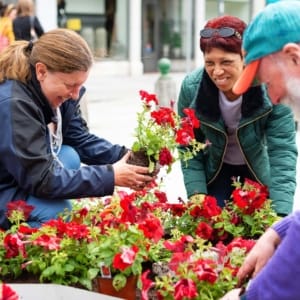
Figure 6. Bill Balaskas, Red Air, 2019. Mixed-media installation (metal, plexiglass, soil, wood, sand, and red flowers) based on the repurposed letters of the TOYOTA advertising signs that used to be installed on the Cork Opera House fly-tower until 2018, dimensions variable. Winner of the TOYOTAYA Commission by the Cork Opera House and the National Sculpture Factory for Cork Midsummer Festival 2019. Photo by Jed Niezgoda.

Figure 7. Bill Balaskas, Red Air, 2019. Environmentalists and agriculturalists of Cork collaborated in the public creation of the installation, including through the choice of plants, soil and other materials. Following the public creation of the work, each pair of letters was donated to a different public garden in Cork. Photos by Jed Niezgoda.
A lot of these futures may incorporate contradictory elements too. This is something that museums will have to navigate much more consciously and holistically. If we look at the role of technology in cultural programming, for instance, we may see more hybrid formats, which, however, will also be more local. This is a likely scenario if we consider that digital connectivity will continue, but climate and socioeconomic pressures will make each museum’s immediate surroundings a primary constituency. That’s why I feel that translocal alliances where institutions collaborate around shared ecological and social urgencies, rather than only around collections, should gain pace. For example this is the logic underpinning the Flying Rivers cultural program, which we announced last November at the Venice Architecture Biennale with the Global Commission on the Economics of Water. Our goal is to bring together cultural institutions from around the world, inspired by the way the hydrological cycle connects different parts of the planet, to collaborate on water issues and mobilize new audiences. However, just like with the cases I mentioned earlier, this cannot be simply a “poetic” gesture. Rather what we need are frameworks directed at both material and immaterial cultural infrastructures, which will allow for climate action—and any other type of social and political action—to be transformative and sustainable. Of course one cannot be sure about the extent to which such initiatives might be embraced. Timing, resources, local struggles, and practical and ideological barriers play a huge role in the formulation of alternative futures. However uncertainty should not be a paralyzing force. It should be an incentive. I feel that this is the most important challenge for audiences around the world and, therefore, the greatest challenge for museums themselves.

Figure 8. Bill Balaskas, As Below, So Above, 2025, performance across the city of Venice, presented in the context of the official public programme of the 19th Venice Architecture Biennale on 13 November 2025. The performance is part of the artist’s ongoing research into the hydrological cycle as a global common good, and a precursor to his new environmental action project Flying Rivers developed in collaboration with the Global Commission on the Economics of Water. The 19th Venice Architecture Biennale, titled Intelligens. Natural. Artificial. Collective., was curated by Carlo Ratti (10 May – 23 November 2025). Photo by Terry Dimoulias.
Bill Balaskas is a London-based artist, theorist, and educator. Originally trained as an economist in Greece, he later studied art in the United Kingdom. Informed by this interdisciplinary background, his practice interrogates socioeconomic and political systems through the lens of contemporary utopias and dystopias. His artworks, performances and lecture-performances have been presented internationally at institutions including MACBA, Barcelona; BOZAR, Brussels; EMST, Athens; CA2M, Madrid; Tate Liverpool; the 11th Sharjah Biennial; the 19th Venice Architecture Biennale; Les Abattoirs, Toulouse; Museum of Contemporary Art, Zagreb; and Transmediale, Berlin. His writing has appeared in the Journal of Visual Culture, Third Text, OnCurating, and e-flux Architecture. His edited books include ‘Fabricating Publics’ (Open Humanities Press, 2021) and ‘Institution as Praxis’ (Sternberg Press, 2020). Balaskas is Director of Research and Knowledge Exchange at the School of Arts at Kingston University, London, where he founded the Centre for Practice Research in the Arts in 2022.
Lora Sariaslan is an art historian, curator, and Assistant Professor of Modern and Contemporary Art at Utrecht University. Her research explores transcultural artistic practices, migration, mobility, cultural identity, and the politics of place and belonging. Sariaslan was previously curator at Istanbul Modern and an assistant curator at the Dallas Museum of Art, experiences that continue to inform her interest in the relationship between scholarship and curatorial practice. As an independent curator she has curated/ co-curated exhibitions internationally. Bringing together art history, curatorial practice, and critical theory, her work examines how artists, museums, and cultural institutions negotiate questions of displacement, representation, and contested histories across geographic and cultural boundaries. Her current research engages with museum collections, mapping, and critical approaches to art history and heritage.
Bill Balaskas was interviewed online by Lora Sariaslan on January 20, 2026.