• Journal
    • Journal Issues
      • Current Issue – Issue #14
      • Issue #13
      • Issue #12
      • Archive
    • About the Journal
      • Aims and Scope
      • Author Guidelines
      • People
      • Ethics
    • Journal Search
      • Search all Journal Articles
  • Projects
    • Research Projects
      • Stedelijk Studies Masters
      • Mortality as Matter
      • Here for Now, Then and There
      • Sketches For The Future
      • Lines of Sight
      • Staff Shares
      • Rakurs
    • Fellowships
      • MMCA Studies x Stedelijk Studies Editorial Fellowship
      • Stedelijk x C& Editorial Fellowship
      • Editorial & Research Fellowships & Fellows
    • Exhibitions
      • MODERN — Van Gogh, Rietveld, Léger and others
      • Exhibition Felix de Rooy — Apocalypse
      • IT’S OUR F***ING BACKYARD
      • Surinamese School
    • Szine
      • Szine is an irregularly published zine that shares pressing research on the subjectivity of the museum in the cultural landscape
    • All projects
      • Ranging from brisk exhibitions to long-term research initiatives, encompassing Szine and Stedelijk Museum Fellowships
  • Research Logs
  • Essays
  • Conversations
  • About
    • About Stedelijk Studies
    • Collaborations
    • People
    • Contact
  • Search
  • Menu Menu
  • Link to Instagram Link to Instagram Link to Instagram
Pablo Picasso giving a drawing lesson to his children Paloma and Claude, and two friends. Photograph by Rene Burri / Magnum.

Pablo Picasso giving a drawing lesson to his children Paloma and Claude, and two friends. Photograph by Rene Burri / Magnum.

Search Search

Exhibition Research: Let Textiles Talk

Picasso

and the Art of Children

Let Textiles Talk Log #7 by Amélie Martelle​

For many modern painters, children pursued a unique experience of the world that allows them to form a distinct and honest expressive style. They believed that at this early stage of life, young ones have an uninhibited relationship with the world, one that absorbs all things beautiful. Several modern artists celebrated the ways in which children are able to render such beauty to simple abstractions. Pablo Picasso famously said:

“Every child is an artist. The problem is how to remain an artist once we grow up.”

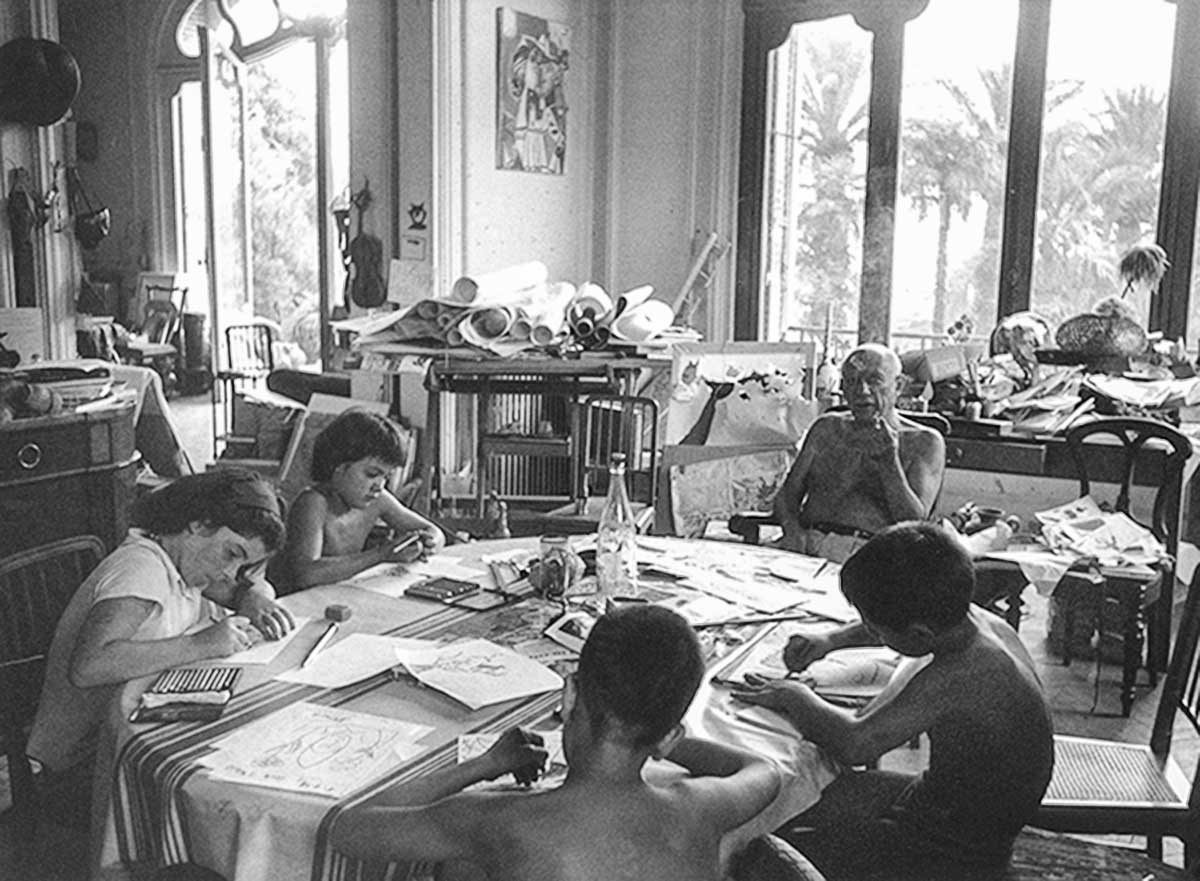
Pablo Picasso’s approach to artistic creation was a mission of undoing, that could only be realised by letting go of the rules and restrictions resulting from the reliance on studying the great masters of art history. Although Picasso expressed his fascination for the Spanish painting tradition, even openly referencing Spanish Renaissance artist El Greco (1541-1614) as an inspiration for his work, he also recognized children’s inherent virtue of innocence and it’s creative potential. A father of four, he welcomed his own children into the studio where they could draw and even collaborate on new projects, lending their playful imagination to radical art making.

Ramses Wissa Wassef’s career follows similar trends – renowned for his academic training, yet dedicated to break with it. As a top student at the French Lycée of Cairo, Wissa Wassef passed an entry exam for the École des Beaux-Arts de Paris with only a 5-month preparation period, which earned him a notable mention in the weekly newspaper Images published in Cairo in 1931. In France, he trained as an architect in the most prestigious art institution of the republic, which even gave rise to a movement of the same name inspired by ancient forms.

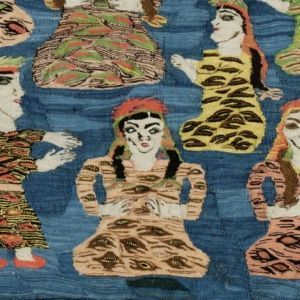
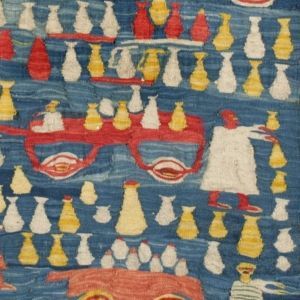
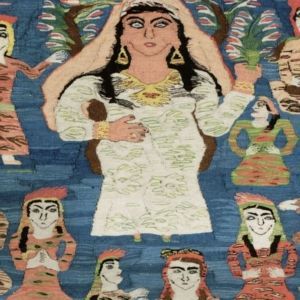
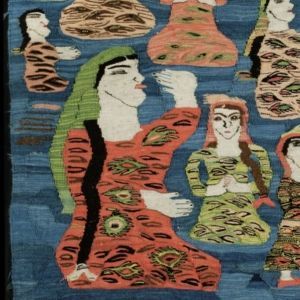
After his studies, he left Europe and its modern ideals behind. He returned to Egypt, where he founded the Wissa Wassef Art Centre, which at the time explicitly set out to challenge the conditions of belonging to the established art history discourse. Wissa Wassef consciously created a space where young makers weaved to their best abilities under conditions that meant to nurture spontaneity in action. The children were not allowed to make any sketches; their imagination had to be directly translated into weaving on the loom. Nor were they allowed to see any examples of Western art, because Wissa Wassef believed that those who see Western art are compelled to copy it.

Whilst Wissa Wassef’s main ambition was to educate the children of Harrania in textiles, his method reflects an expressive pursuit shared with modern artists interested in the experimentation and spontaneity that resulted in the simplified visual language and expressive use of color promoted in the twentieth century. Art brut, naïve art, outsider art, and folk art emerged as overlapping labels to define the valorisation of works by makers with no formal art training. All of which spurred a question that challenged the notions of belonging to the art world to this day: when is something art or someone an artist?

Pablo Picasso giving a drawing lesson to his children Paloma and Claude, and two friends. Photograph by Rene Burri / Magnum.

Pablo Picasso giving a drawing lesson to his children Paloma and Claude, and two friends. Photograph by Rene Burri / Magnum.

Pablo Picasso giving a drawing lesson to his children Paloma and Claude, and two friends. Photograph by Rene Burri / Magnum.

«Source gallica.bnf.fr / Bibliothèque nationale de France » ou « Source gallica.bnf.fr / BnF».
Weekly Egyptian magazine, Images (1931)

«Source gallica.bnf.fr / Bibliothèque nationale de France » ou « Source gallica.bnf.fr / BnF».  Weekly Egyptian magazine, Images (1931)

Pablo Picasso giving a drawing lesson to his children Paloma and Claude, and two friends. Photograph by Rene Burri / Magnum.

This article is tagged with:
egypt (6)material culture (26)paintings (34)participation (31)research design (13)

Sources

Fineberg, Jonathan. The Innocent Eye : Children’s Art and the Modern Artist. Princeton, NJ: Princeton University Press, 1997.

«Source gallica.bnf.fr / Bibliothèque nationale de France » ou « Source gallica.bnf.fr / BnF».

Weekly Egyptian magazine, Images (1931)

Pablo Picasso giving a drawing lesson to his children Paloma and Claude, and two friends. Photograph by Rene Burri/Magnum. Source – The innocent eye : children’s art and the modern artist by Jonathan Finberg

«Source gallica.bnf.fr / Bibliothèque nationale de France » ou « Source gallica.bnf.fr / BnF».

Weekly Egyptian magazine, Images (1931)

More about Let Textiles Talk

Made in Harrania?
February 18, 2022/by Stedelijk Studies

Made in Harrania?

by Amanda Pinatih
Pablo Picasso giving a drawing lesson to his children Paloma and Claude, and two friends. Photograph by Rene Burri / Magnum.Rene Burri / Magnum.
January 7, 2022/by Stedelijk

Picasso and the Art of Children

by Amélie Martelle​
How Textiles Talk and What They Have to Say. A Curatorial Introduction to the Exhibition Let Textiles Talk by Amanda Pinatih.
December 16, 2021/by Stedelijk

How Textiles Talk and What They Have to Say

Essay by Amanda Pinatih
An interview with Ali Selim
September 14, 2021/by Stedelijk Studies

An interview with Ali Selim

Log #6 by Amélie Martelle​
Visitors of the Wissa Wassef Centre
September 1, 2021/by Stedelijk

Visitors of the Wissa Wassef Centre

Log #5 by Amélie Martelle​
Diving into the Stadsarchiefs Amsterdam
August 15, 2021/by Stedelijk

Diving into the Stadsarchief Amsterdam

Log #4 by Amélie Martelle​
Serendipity
August 1, 2021/by Stedelijk

Serendipity

Log #3 by Amanda Pinatih
Checking the tapestries in the depot
July 19, 2021/by Stedelijk

The tapestries IRL

Log #2 by Amanda Pinatih
July 5, 2021/by Stedelijk

Meeting the Collection

Log #1 by Amanda Pinatih

Yayoi Kusama

YAYOI KUSAMA
PRE-SALE NOW LIVE
Exhibition — Sep 11, 2026 till Jan 17, 2027

Newsletter

Subscribe to Stedelijk Museum’s Academic Newsletter.

Share this page

  • Facebook Facebook Share on Facebook
  • Whatsapp Whatsapp Share on WhatsApp
  • Pinterest Pinterest Share on Pinterest
  • Linkedin Linkedin Share on LinkedIn

Stedelijk Studies on Instagram

Connect to Stedelijk Studies on Instagram

Subscribe to the Stedelijk Museum Academic Newsletter

Get the latest research, insights, and updates from Stedelijk Studies. Subscribe to the Stedelijk Museum’s Academic Newsletter.

© 2026 Stedelijk Studies.
  • Link to Instagram Link to Instagram Link to Instagram
  • Disclaimer
  • Colophon
  • Contact
  • Cookie Policy
  • Privacy Statement
Scroll to top Scroll to top Scroll to top
Stedelijk Studies
Manage Consent
To provide the best experiences, we use technologies like cookies to store and/or access device information. Consenting to these technologies will allow us to process data such as browsing behavior or unique IDs on this site. Not consenting or withdrawing consent, may adversely affect certain features and functions.
Functional Always active
The technical storage or access is strictly necessary for the legitimate purpose of enabling the use of a specific service explicitly requested by the subscriber or user, or for the sole purpose of carrying out the transmission of a communication over an electronic communications network.
Preferences
The technical storage or access is necessary for the legitimate purpose of storing preferences that are not requested by the subscriber or user.
Statistics
The technical storage or access that is used exclusively for statistical purposes. The technical storage or access that is used exclusively for anonymous statistical purposes. Without a subpoena, voluntary compliance on the part of your Internet Service Provider, or additional records from a third party, information stored or retrieved for this purpose alone cannot usually be used to identify you.
Marketing
The technical storage or access is required to create user profiles to send advertising, or to track the user on a website or across several websites for similar marketing purposes.
  • Manage options
  • Manage services
  • Manage {vendor_count} vendors
  • Read more about these purposes
View preferences
  • {title}
  • {title}
  • {title}