• Journal
    • Journal Issues
      • Current Issue – Issue #14
      • Issue #13
      • Issue #12
      • Archive
    • About the Journal
      • Aims and Scope
      • Author Guidelines
      • People
      • Ethics
    • Journal Search
      • Search all Journal Articles
  • Projects
    • Research Projects
      • Stedelijk Studies Masters
      • Mortality as Matter
      • Here for Now, Then and There
      • Sketches For The Future
      • Lines of Sight
      • Staff Shares
      • Rakurs
    • Fellowships
      • MMCA Studies x Stedelijk Studies Editorial Fellowship
      • Stedelijk x C& Editorial Fellowship
      • Editorial & Research Fellowships & Fellows
    • Exhibitions
      • MODERN — Van Gogh, Rietveld, Léger and others
      • Exhibition Felix de Rooy — Apocalypse
      • IT’S OUR F***ING BACKYARD
      • Surinamese School
    • Szine
      • Szine is an irregularly published zine that shares pressing research on the subjectivity of the museum in the cultural landscape
    • All projects
      • Ranging from brisk exhibitions to long-term research initiatives, encompassing Szine and Stedelijk Museum Fellowships
  • Research Logs
  • Essays
  • Conversations
  • About
    • About Stedelijk Studies
    • Collaborations
    • People
    • Contact
  • Search
  • Menu Menu
  • Link to Instagram Link to Instagram Link to Instagram

Call for Research

Stedelijk  Studies Journal  #12

Submission deadline:  March 1, 2022

The “Diaspora” describes mass movements of displaced peoples, or the scattering of a people away from their geographical “origin”, while objects and ideas have their own flow and transport, displayed through conventions of the elsewhere, usually “the West”. Diasporic frameworks are part of the decolonializing and postcolonial constellations within contemporary art discourse, and international exhibitions have begun to set broader contours of the Diaspora that resist historically imperialist narratives. Yet, the practices, policies, and strategies around responsibility for the “Collection” of these objects in this framework is still forming on the institutional level. Our Call for Research for issue 12 of the Stedelijk Studies Journal seeks approaches, ideas, and experimental projects that align with the broad scope of the Diaspora as a framework for the critical examination of museum collection strategies.

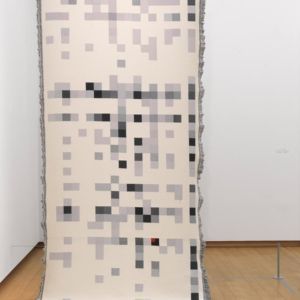
Design by Rossella Biscotti, executed by Textiellab Tilburg, 10 x 10 (Acquired Nationality), 2014. Stedelijk Museum Amsterdam, object no. 2015.1.0418(1-2).

Design by Rossella Biscotti, executed by Textiellab Tilburg, 10 x 10 (Acquired Nationality), 2014. Stedelijk Museum Amsterdam, object no. 2015.1.0418(1-2).

We are interested in how the Diasporic frameworks are a possible foundation for collection policies based on kinship building and strengthening cultural affiliations, as well as how movement and relocation can be applied to a collection’s display and mediation. Further, the issue concerns the histories of peoples and objects, and the speculative possibilities for museums that grapple with the responsibility of being cultural mediators today.

Stedelijk Museum Amsterdam is currently taking steps in rethinking its acquisition and exhibition strategies. The first step it has taken is to reconsider its collection of over 100,000 pieces into two spheres. The first comprises works that belong to the long twentieth century in which modernism was central—a collection that the museum acknowledges as its foundation and raison d’être. Many of the works that are considered to belong to the “diverse” part of the collection, are made by artists within the worldwide European Diaspora—which can be seen as a regionalist repatriation and continuation of the Western canon of modern art.

The second sphere is concerned with recently acquired works and is motivated by emigrational movements, postcolonial constellations, and community engagement. By breaking away from the modernist acquisition strategies that formed the core of the Stedelijk’s foundational collection, the museum can now examine how plural Diasporas can incorporate the complexities of objects and people. As custodians of the collection, we are obligated to care for it, now and for future generations, which means building in-roads for multiple heritages. While maintaining its steadfast recognition of the past as a source of (un)learning, the collection is then allowed a more open future as we are guided by deep research, critique, and care.

We understand that “Diaspora” does not undo the logic of coloniality and modernity and could even be interpreted as reinscribing these systems. However, as our current period suggests, global movements are diverse and multiple, and the Stedelijk Studies Journal Issue 12 seeks out those complex connections between all agents, both animate and inanimate. While we are interested in the prospects that emerge from Diasporic acquisition strategies, we also understand systems are persistent and we will take extra care in considering contexts, and to give historical and speculative models equal weight.

Subjects to be considered in relation to Diaspora include and are not limited to:

  1. Community practices of artistic heritage that counter institutional display
  2. Diasporic belonging through cultural production
  3. Intersections of the Diaspora: race, class, and other dynamics
  4. Ways of thinking beyond the social and philosophical foundations of the museum
  5. Alternative museum practices / speculative futures for museums or institutions
  6. Historical museum collection and exhibition practices around regions, civilizations, people
  7. Dealing with Whiteness in museum collections today
  8. Museological diversification and decolonization
  9. Repatriation of cultural objects, and representing the “absence” or “return” of objects

Process

To work toward an environment in which intellectual and artistic labor are equally valued, Stedelijk Studies Journal has made it part of its process to incorporate peer-reviewed artistic practices. Consequently, unlike Stedelijk Studies Journal’s previous calls for written papers, this “Call for Research” welcomes knowledge transmissions in all its forms: from academic writing to the full range of artistic media. The issue editors seek contributions that add thoroughly researched, idiosyncratic perspectives to current debates, particularly those that leap into the speculative.

All accepted submissions are subject to scholarly or artistic peer review, and all contributors must be open to receive such feedback and work collaboratively toward a final version.

As a way to open up the peer-reviewed process further we will compensate published submissions with a symbolic fee of 400 EUR (excl. VAT).

Submission

The deadline for the abstract or artwork proposal (max. 300 words and optionally max. 5 images) and CV (merged in one PDF file) is March 1, 2022

The deadline for the written article (4,000–5,000 words) or unwritten contribution (form to be discussed with the issue editors after acceptance) is June 7, 2022.

The issue will be published in December 2022.

Please send abstracts, proposals, and other editorial correspondence to Meredith North, managing editor: [email protected]

About

Stedelijk  Studies Journal  is a high-quality, peer-reviewed academic journal published by the  Stedelijk Museum Amsterdam. The journal comprises  research  related to the  Stedelijk  collection, exploring institutional history, museum  studies, and current topics in the field of art and design.

Issue 12 is edited by Charl Landvreugd, who will gather a topical editorial group around the abstracts selected.
Call for Research Archive

Stedelijk Studies Masters 2026
May 1, 2026/by Stedelijk

Call for Submissions: Stedelijk Studies Masters 2026

Stedelijk Studies #15: Audiences for Contemporary Art Museums
June 13, 2024/by Stedelijk

Call for Research  Stedelijk  Studies Journal  #15

Submission deadline: September 2, 2024
Stedelijk Studies Master’s Research
May 1, 2024/by Stedelijk

Stedelijk Studies Masters

Stedelijk Studies is currently welcoming Master’s Theses on and relating to the Stedelijk Museum Amsterdam and its collection.
FANDANGOS NR. 6 Creators: Raul Marroquin - editor, Marjo Schumans - editor, Agora Studio - publisher, Jan van Eyck Academie - printer. Donation Artists' Books Johan Deumens, Landgraaf.
December 19, 2022/by Stedelijk

Call for Research  Stedelijk  Studies Journal  #14

Submission deadline:  March 20, 2023
AnnaMaria Pinaka, “untitled” (part of series Thirsty Pig), 2022. Ink and watercolors. Photo by AnnaMaria Pinaka.
July 26, 2022/by Stedelijk

Call for Research  Stedelijk  Studies Journal  #13

*CLOSED*
Design by Rossella Biscotti, executed by Textiellab Tilburg, 10 x 10 (Acquired Nationality), 2014. Stedelijk Museum Amsterdam, object no. 2015.1.0418(1-2).
January 31, 2022/by Stedelijk

Call for Research  Stedelijk  Studies Journal  #12

*CLOSED*
Figure 3b. Detail
December 11, 2020/by Stedelijk

Call for Papers – Stedelijk Studies Spring 2021

*CLOSED*
Stedelijk Studies Spring 2020 – Call for Papers
May 6, 2019/by Editor

Stedelijk Studies Spring 2020 – Call for Papers

*CLOSED*
January 15, 2019/by Editor

Stedelijk Studies Fall 2019 – Call for Papers

*CLOSED*
July 10, 2018/by Editor

Stedelijk Studies Summer 2019 – Call for Papers

*CLOSED*
November 17, 2017/by Editor

Stedelijk Studies Summer 2018 – Call for Papers

*CLOSED*
January 13, 2017/by Editor

Stedelijk Studies Summer 2017 – Call for Papers

*CLOSED*
February 1, 2015/by Stedelijk

Stedelijk Studies Fall 2015 Performance – Call for Papers

*CLOSED*
Photo: Gert-Jan van Rooij
October 28, 2014/by Stedelijk

Stedelijk Studies Fall 2016 – Call for Papers

*CLOSED*

Journal Archive

Explore the Stedelijk Studies Journal Archive.

Call for Research Archive

Find Call for Research Archive here.

Newsletter

Subscribe to Stedelijk Museum’s Academic Newsletter.

Share this page

  • Facebook Facebook Share on Facebook
  • Whatsapp Whatsapp Share on WhatsApp
  • Pinterest Pinterest Share on Pinterest
  • Linkedin Linkedin Share on LinkedIn

Stedelijk Studies on Instagram

Connect to Stedelijk Studies on Instagram

Subscribe to the Stedelijk Museum Academic Newsletter

Get the latest research, insights, and updates from Stedelijk Studies. Subscribe to the Stedelijk Museum’s Academic Newsletter.

© 2026 Stedelijk Studies.
  • Link to Instagram Link to Instagram Link to Instagram
  • Disclaimer
  • Colophon
  • Contact
  • Cookie Policy
  • Privacy Statement
Scroll to top Scroll to top Scroll to top
Stedelijk Studies
Manage Consent
To provide the best experiences, we use technologies like cookies to store and/or access device information. Consenting to these technologies will allow us to process data such as browsing behavior or unique IDs on this site. Not consenting or withdrawing consent, may adversely affect certain features and functions.
Functional Always active
The technical storage or access is strictly necessary for the legitimate purpose of enabling the use of a specific service explicitly requested by the subscriber or user, or for the sole purpose of carrying out the transmission of a communication over an electronic communications network.
Preferences
The technical storage or access is necessary for the legitimate purpose of storing preferences that are not requested by the subscriber or user.
Statistics
The technical storage or access that is used exclusively for statistical purposes. The technical storage or access that is used exclusively for anonymous statistical purposes. Without a subpoena, voluntary compliance on the part of your Internet Service Provider, or additional records from a third party, information stored or retrieved for this purpose alone cannot usually be used to identify you.
Marketing
The technical storage or access is required to create user profiles to send advertising, or to track the user on a website or across several websites for similar marketing purposes.
  • Manage options
  • Manage services
  • Manage {vendor_count} vendors
  • Read more about these purposes
View preferences
  • {title}
  • {title}
  • {title}